9 Best PPFD Meters for Cannabis (November 2026)
The best PPFD meters for cannabis include the DANOPLUS Quantum PAR Meter Full-Spectrum High Precision for most cannabis grow rooms, the AquaHorti AH-Quantuv PAR Meter for Grow Lights for UVA and spectrum detail, and the VABIRA VBR-100 Quantum PAR Meter 6000umol/ for Bluetooth grid mapping.
On this page (6 sections)
The best PPFD meter for cannabis is the DANOPLUS Quantum PAR Meter for most indoor growers. It covers 0–5000 μmol/m²/sec, measures 400–700 nm PAR light, stores up to 100 values and has a tripod socket for steadier readings.
A good meter helps you measure canopy light instead of guessing from fixture wattage or hanging height. It can show whether the center is much brighter than the edges, whether a dimmer change reached the intended level and whether plants at different heights receive similar light.
If you need a quick explanation of the measurement itself, read what is PPFD in grow lights. You can also compare the broader group of best PAR light meters for plants before choosing a meter for a mixed indoor garden.
Our picks at a glance
-
1
 Best for most cannabis grow rooms
DANOPLUS Quantum PAR Meter Full-Spectrum High Precision
9.6/10 our score
See it on Amazon -
2
 Best for UVA and spectrum detail
AquaHorti AH-Quantuv PAR Meter for Grow Lights
9.5/10 our score
See it on Amazon -
3
 Best for Bluetooth grid mapping
VABIRA VBR-100 Quantum PAR Meter 6000umol/
9.4/10 our score
See it on Amazon
- 4
 Check it
PHOTOBIO Advanced Quantum PAR Meter
Best for a complete sensor kit - 5
 Check it
VIVOSUN Digital Hygrometer Thermometer
Best for light and climate records - 6
 Check it
Gain Express Quantum PAR Meter for LED Grow
Best for simple 100-reading scans - 7
 Check it
EDGEVEIL 4-in-1 Soil Moisture Meter for Plants
Best for adding root-zone checks - 8
 Check it
Amprobe THWD-5 Relative Humidity and Temperature Meter
Best for wet-bulb and dew-point readings - 9
 Check it
Elaphodus PAR Meter for LED Grow Lights
Best for remote-sensor value
The best PPFD meters for cannabis
The best PPFD meter depends on how much detail you need from each reading. DANOPLUS is the strongest general choice, AquaHorti adds UVA and color information, and VABIRA is the most useful pick here for app-based mapping.
We compared measurement ranges, wavelength coverage, recording tools, sensor placement and the type of information each meter can add to a cannabis lighting routine. Our score weighs specs, features and buyer feedback against what you're shopping for.
| Product | Best for | Measurement range | PAR range | Stored readings | Our score |
|---|---|---|---|---|---|
| DANOPLUS Quantum PAR Meter Full-Spectrum High Precision | most cannabis grow rooms | 0–5000 μmol/m²/sec | 400–700 nm, ±10 nm tolerance | Up to 100 | 9.6 |
| AquaHorti AH-Quantuv PAR Meter for Grow Lights | UVA and spectrum detail | 400–750 nm | 9.5 | ||
| VABIRA VBR-100 Quantum PAR Meter 6000umol/ | Bluetooth grid mapping | Up to 6000 μmol/(㎡s) | 9.4 | ||
| PHOTOBIO Advanced Quantum PAR Meter | a complete sensor kit | 400–700 nm | Up to 99 | 9.1 | |
| VIVOSUN Digital Hygrometer Thermometer | light and climate records | 8.8 | |||
| Gain Express Quantum PAR Meter for LED Grow | simple 100-reading scans | 0–5000 μmol/m²/sec | 400–700 nm, ±10 nm | Up to 100 | 8.7 |
| EDGEVEIL 4-in-1 Soil Moisture Meter for Plants | adding root-zone checks | 8.4 | |||
| Amprobe THWD-5 Relative Humidity and Temperature Meter | wet-bulb and dew-point readings | 8.1 | |||
| Elaphodus PAR Meter for LED Grow Lights | remote-sensor value | 0–4000 μmol/m²s | 400–700 nm | Up to 99 | 7.8 |
DANOPLUS Quantum PAR Meter Full-Spectrum High Precision: Best for most cannabis grow rooms
- 0–5000 μmol/m²/sec range
- 400–700 nm PAR range
- Stores 100 readings
- Tripod socket
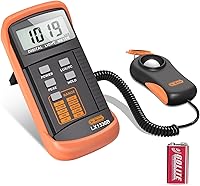
The DANOPLUS combines a broad PPFD range with 100-reading storage and a tripod socket. It suits growers who want repeatable canopy checks without needing app-based mapping.
Pros
- Wide 0–5000 μmol/m²/sec range
- Stores 100 readings
- Tripod socket
Cons
- Does not provide the separate UVA and RGB breakdown shown by some picks
- Tripod is not included
DANOPLUS is the best fit for most cannabis grow rooms because its 0–5000 μmol/m²/sec range covers ordinary canopy checks while leaving room for brighter measurements. Its 400–700 nm range targets the PAR band used for photosynthesis.
The meter stores up to 100 measured values and displays the last 4 recorded data points in real time. That makes it useful when you move across the center, corners and edges of a canopy and want to compare recent readings without writing every value immediately.
A tripod socket gives you another way to keep the meter stable during repeated measurements. The tripod isn't included, so treat that socket as a mounting option rather than a complete stand system.
Its compact 8.8 oz body is easier to carry between a grow tent, greenhouse or other growing area. Pick DANOPLUS when you want a straightforward PPFD workflow with useful memory and no required phone app.
AquaHorti AH-Quantuv PAR Meter for Grow Lights: Best for UVA and spectrum detail
- 400–750 nm PAR measurement
- 320–400 nm UVA measurement
- Blue, green and red PAR breakdown
- Stores 100 PAR measurements
- 2 AAA batteries included
AquaHorti is a strong choice when total PPFD is only part of the lighting question. Its UVA reading and blue, green and red breakdown add spectrum information for growers adjusting different growth stages.
Pros
- Measures PAR and UVA
- Shows blue, green and red PAR separately
- Records up to 100 readings
Cons
- More information may be unnecessary for simple intensity checks
- No app-based mapping is described
AquaHorti is the best PPFD meter for cannabis when spectrum detail matters as much as total intensity. It measures PAR from 400–750 nm and UVA from 320–400 nm, then shows separate blue, green and red PAR contributions.
That breakdown can help you compare what a fixture delivers during different growth stages. Blue PAR, green PAR and red PAR are shown separately, so you can study the balance instead of relying on one combined number.
The meter records up to 100 PAR measurements for light distribution checks. Its HOLD function keeps a reading stable while you observe it, and 2 AAA batteries are included.
Choose AquaHorti if you want UVA information or a more detailed view of the light spectrum. It may be more information than you need if your only task is checking whether the center and edges have similar PPFD.
VABIRA VBR-100 Quantum PAR Meter 6000umol/: Best for Bluetooth grid mapping
- 400–700 nm PAR and PPFD measurement
- RGB PAR breakdown
- PPFD grid mapping
- Uniformity analysis
- Bluetooth app
The VABIRA VBR-100 is built for growers who want to map several canopy points and review light uniformity. Its Bluetooth app can download data for further analysis, while the meter also shows separate blue, green and red PAR components.
Pros
- Grid mapping and uniformity analysis
- Bluetooth app
- Works under mixed lighting conditions
Cons
- Requires a Bluetooth-enabled smartphone for app features
- More involved than a single-point meter
VABIRA's VBR-100 is the best choice for growers who want Bluetooth grid mapping and uniformity analysis. It measures PAR and PPFD from 400–700 nm and can record multiple grid points to assess how evenly light reaches the grow area.
The meter also shows blue, green and red PAR components separately. Its app can connect to Bluetooth-enabled smartphones, and recorded data can be downloaded for further analysis.
VABIRA describes the VBR-100 as suitable for mixed lighting such as LED with HPS or sunlight. It also identifies the same physical hardware under the VBR-100 Plus app name, where the Plus label refers to enhanced mobile software rather than different hardware.
This is a strong option for larger tents, greenhouse sections or fixtures where the center-to-edge difference matters. Choose another meter if you prefer a simple handheld display without phone pairing.
PHOTOBIO Advanced Quantum PAR Meter: Best for a complete sensor kit
- 400–700 nm PAR range
- Stores up to 99 readings
- Remote sensor
- Short-coiled and 12 ft straight cables
- Protective carrying case
PHOTOBIO includes a remote sensor, two connection cables, AAA batteries and a protective carrying case. It fits growers who need to place the sensor at different points while keeping the main unit accessible.
Pros
- Remote sensor included
- 12 ft straight cable included
- Stores up to 99 readings
Cons
- Heavier and larger than several handheld options
- The stated range is narrower than VABIRA's
PHOTOBIO suits growers who want a remote sensor and a complete measuring kit. It measures 400–700 nm PAR light and stores up to 99 readings for comparing light levels after you change fixture height or dimmer settings.
The package includes the main unit, remote sensor, short-coiled cable, 12 ft straight cable, AAA batteries and a protective carrying case. The long straight cable helps you reach distant measurement points while keeping the main unit in hand.
PHOTOBIO is described for modern LED fixtures, HPS DE grow lights and other traditional indoor grow lights. Its 1.12 lb weight is higher than several compact meters here, so it is better suited to a planned measuring routine than constant pocket carry.
Pick it when cable reach and included sensor parts matter. If you mainly need a lightweight meter with a wider maximum range, DANOPLUS or VABIRA may fit better.
VIVOSUN Digital Hygrometer Thermometer: Best for light and climate records
- Temperature and humidity monitoring
- External sensor probe
- Bluetooth app
- VPD display
- 2-year free data storage
The VIVOSUN is not a PPFD meter, but it helps you record the climate beside your light measurements. Its built-in sensor, external probe, VPD display and Bluetooth alerts suit growers who want light and environmental notes together.
Pros
- External probe for dual-channel monitoring
- Bluetooth app alerts
- VPD display
Cons
- Does not measure PPFD
- Adds climate data rather than spectrum data
VIVOSUN is the best supporting tool here for growers who want climate records beside their light readings. It measures temperature and humidity through a built-in sensor and an external probe, then connects to the Vivosun app by Bluetooth.
Its display includes VPD data, high and low temperature and humidity records, and comfort-range indicators. App alerts can notify you when temperature or humidity passes your chosen limits, while 2 years of free data storage supports longer comparisons.
This device does not measure PPFD, PAR or spectrum. Use it beside a dedicated light meter when you want to note whether canopy changes happen alongside a change in room climate.
The external probe also gives you a second position to monitor. Choose VIVOSUN when environmental context is part of your grow log, not as a replacement for a quantum PAR meter.
Gain Express Quantum PAR Meter for LED Grow: Best for simple 100-reading scans
- 0–5000 μmol/m²/sec range
- 400–700 nm range
- MAX, MIN and AVG functions
- Stores up to 100 readings
- Large display
Gain Express gives you a clear handheld workflow for scanning several points and reviewing maximum, minimum and average values. It suits growers who want useful scan data without spectrum breakdowns or smartphone mapping.
Pros
- MAX, MIN and AVG functions
- Stores 100 readings
- Large display
Cons
- No separate RGB breakdown is described
- Requires 2 AAA batteries
Gain Express is a good fit for simple scans with MAX, MIN and AVG values. It measures 0–5000 μmol/m²/sec across 400–700 nm and stores up to 100 measurements.
The dynamic mode records readings while you scan an area until you hold or power off the meter. It then calculates average, maximum and minimum values, which can help summarize a pass across several canopy points.
A large display makes the main reading easy to check while you move the sensor. The meter uses 2 AAA batteries, and its workflow stays focused on light intensity rather than app mapping or separate spectrum channels.
Choose Gain Express if scan summaries matter more than RGB or UVA data. It is especially useful when you want to compare the range of readings across a canopy without building a phone-based map.
EDGEVEIL 4-in-1 Soil Moisture Meter for Plants: Best for adding root-zone checks
- Soil moisture, temperature, light level and clock
- Wireless range up to 328 ft
- Low-moisture alert
- Supports up to 12 sensors
- 2 AAA batteries included
EDGEVEIL does not measure canopy PPFD, but it can add root-zone moisture and soil temperature context to a lighting log. Its wireless display and support for up to 12 sensors suit larger plant collections.
Pros
- Monitors soil moisture and temperature
- Wireless display
- Supports up to 12 sensors
Cons
- Not a PPFD meter
- Its light reading is not described as PAR or PPFD
EDGEVEIL is the best supporting pick for root-zone checks alongside canopy light readings. Its 4-in-1 display shows soil moisture, soil temperature, sunlight time and a real-time clock.
The wireless range reaches up to 328 ft, and one display can connect with up to 12 sensors. That setup can help you monitor several containers or growing areas without repeatedly inserting a handheld probe into each pot.
EDGEVEIL does not report PPFD or PAR. Its light reading is not described as a horticultural photon measurement, so don't use it to set canopy intensity.
Choose it when watering and soil temperature are part of the same care routine. Pair it with a dedicated PPFD meter for lighting decisions.
Amprobe THWD-5 Relative Humidity and Temperature Meter: Best for wet-bulb and dew-point readings
- Relative humidity measurement
- Temperature measurement
- Wet-bulb reading
- Dew-point reading
- Extended probe
The Amprobe THWD-5 is a climate tool for growers who need humidity, temperature, wet-bulb and dew-point readings alongside light checks. It does not measure PPFD, so pair it with a dedicated PAR meter.
Pros
- Four climate readings
- Extended probe
- Stores minimum and maximum measurements
Cons
- Does not measure PPFD
- No light measurement is described
Amprobe's THWD-5 is the best supporting tool for wet-bulb and dew-point readings. It measures relative humidity, temperature, dew point and wet bulb through an extended probe.
The meter stores minimum and maximum measurements, and its operating humidity range is 0–100% RH. Those readings can add climate context when you review a light log, especially if you are tracking how the room changes during the light cycle.
It does not measure PPFD, PAR or light spectrum. Use it as a climate meter, not as a substitute for a quantum sensor.
Choose Amprobe when humidity and dew point are more important than app alerts or VPD display. Its extended probe is useful when the target point is harder to reach directly.
Elaphodus PAR Meter for LED Grow Lights: Best for remote-sensor value
- 0–4000 μmol/m²s range
- 400–700 nm PAR range
- Stores 99 readings
- Remote sensor
- 12 ft straight cable
Elaphodus offers a split-design PAR meter with a remote sensor, short-coiled cable and 12 ft straight cable. It suits growers who need to reach distant canopy points while keeping the price tier and feature set simple.
Pros
- Remote sensor design
- 12 ft straight cable
- Stores 99 measurements
Cons
- Lower maximum range than the 5000 and 6000 picks
- No RGB breakdown or app is described
Elaphodus is the best value-oriented pick for remote-sensor measurements. It measures 0–4000 μmol/m²s across 400–700 nm and stores up to 99 historical readings.
The split design includes a remote sensor, a short-coiled cable and a 12 ft long-straight cable. That arrangement helps you place the sensor at a distant canopy point while keeping the display in a convenient position.
Its maximum range is lower than the 5000 and 6000 μmol/m²/sec options above. For many indoor checks, that may be enough, but compare your expected readings with the meter's range before choosing it for a high-intensity setup.
Pick Elaphodus when remote placement matters and you want a focused PAR meter. Choose VABIRA instead if you need app mapping or uniformity analysis.
What should you measure when setting cannabis lights?
Measure PPFD at canopy height across a repeatable grid, then adjust the fixture or dimmer based on the pattern. A single center reading can hide weak edges or bright areas that may affect plants at different positions.
Keep the sensor level and use the same grid points each time. Record the center, corners and several points between them, then repeat after changing light height, intensity or plant placement.
For a deeper look at fixture placement, read How Far Should a Grow Light Be from Plants?. Light distance changes the pattern across the canopy, so record the distance and dimmer setting with each reading.
Do you need spectrum data or only PPFD?
Most growers need total PPFD first, while spectrum data becomes more useful when you are comparing fixtures or studying growth-stage lighting. A meter with RGB or UVA readings costs attention as well as money, so choose those features only when you will use them.
DANOPLUS and Gain Express focus on the main 400–700 nm PAR range with stored readings. AquaHorti adds UVA plus blue, green and red breakdowns, while VABIRA combines RGB data with app-based distribution mapping.
If you are still comparing fixtures, start with Best Grow Lights For Cannabis before choosing a meter. The best meter cannot correct a fixture that does not cover your space evenly.
How do you choose a PPFD meter for cannabis?
Choose by measurement range, sensor placement and the amount of data you want to keep. A basic handheld meter works for occasional center and edge checks, while a remote sensor or app map helps with larger or more complex spaces.
Look for these traits:
- A PAR range that matches the readings you expect.
- A sensor that can sit level at canopy height.
- Stored readings if you compare several grid points.
- A tripod socket, cable or app when repeatability matters.
- UVA or RGB readings only if spectrum detail supports your decisions.
- A separate climate meter if temperature, humidity or VPD is part of your record.
Your setup should also shape the choice. DANOPLUS is compact and stores 100 readings, PHOTOBIO and Elaphodus use remote sensors, and VABIRA is designed around Bluetooth mapping.
How should you use and care for a PPFD meter?
Use the same measurement routine each time, keep the sensor clean and protect the meter from avoidable moisture. Consistent placement matters because readings from different heights or angles are difficult to compare.
Before measuring, let the grow light operate under the conditions you want to evaluate. Hold the sensor at canopy height, keep it level, pause long enough for a stable reading and record the location.
Avoid pressing the sensor into leaves or moving it during the reading. If you use a tripod, remote cable or phone map, keep that setup consistent between checks.
Store the meter in a dry, protected place after use. Replace batteries according to the device instructions, and keep any included case or cable with the meter so the next measurement session starts with the same parts.
Which is the best PPFD meter for cannabis?
The DANOPLUS Quantum PAR Meter is the best PPFD meter for cannabis for most growers because it combines a 0–5000 μmol/m²/sec range, 400–700 nm PAR coverage, 100-reading storage and tripod mounting.
Choose AquaHorti if you need UVA and blue, green and red breakdowns. Choose VABIRA for Bluetooth grid mapping and uniformity analysis, PHOTOBIO or Elaphodus for remote sensors, and Gain Express for MAX, MIN and AVG scan summaries.
If you are comparing the Apogee range, continue with best apogee ppfd meter. Pick the meter that matches the way you'll measure, record and adjust your canopy.
Our top 3 picks at a glance
-
1
Best for most cannabis grow rooms
DANOPLUS Quantum PAR Meter Full-Spectrum High Precision
9.6/10 our score
See it on Amazon -
2
Best for UVA and spectrum detail
AquaHorti AH-Quantuv PAR Meter for Grow Lights
9.5/10 our score
See it on Amazon -
3
Best for Bluetooth grid mapping
VABIRA VBR-100 Quantum PAR Meter 6000umol/
9.4/10 our score
See it on Amazon
Frequently asked questions
What is the best PPFD meter for cannabis?
The DANOPLUS is the best PPFD meter for cannabis for most growers because it measures 400–700 nm PAR, covers 0–5000 μmol/m²/sec and stores 100 readings. Choose AquaHorti for UVA and color breakdowns, or VABIRA when grid mapping and uniformity analysis matter more.
Why use a PPFD meter for cannabis?
A PPFD meter shows how much photosynthetically active light reaches the canopy. Use repeated readings to find bright and dim areas, then adjust fixture height, dimming or plant position.
The goal is a measured, even canopy rather than relying only on a light's power rating.
What range should a cannabis PPFD meter measure?
A useful cannabis PPFD meter should cover the expected canopy readings without reaching its limit. The picks here range from 0–4000 to 0–6000 μmol/m²/sec, while several cover 400–700 nm PAR.
Choose the range based on your fixture and measurement position.
Are PAR meters and PPFD meters the same?
The terms are closely related, but they describe different parts of the measurement. PAR refers to the 400–700 nm light range used for photosynthesis, while PPFD describes the number of photons reaching an area each second.
Many horticultural meters measure PPFD within the PAR range.
How do you measure PPFD across a cannabis canopy?
Measure a grid of points at canopy height, keeping the sensor level at each point. Record the center, edges and corners, then compare the readings for bright and dim zones.
A meter with stored readings or app mapping makes this process easier to repeat after you change the light.