6 Best Apogee PPFD Meters (November 2026)
The best Apogee PPFD meters for measuring plant light include the DANOPLUS Quantum PAR Meter Full-Spectrum High Precision for saved spot checks, the AquaHorti AH-Quantuv PAR Meter for Grow Lights for spectrum breakdown, and the VABIRA VBR-100 Quantum PAR Meter 6000umol/ for mapped grow areas.
On this page (5 sections)
The best Apogee PPFD meter alternative for most grow spaces is the AquaHorti AH-Quantuv, which measures PAR and UVA and shows blue, green and red PAR separately. Choose VABIRA for grid mapping, DANOPLUS for saved spot checks, or VidalKraft if DLI readings matter to you.
An Apogee meter is often considered when a grower wants dependable readings of plant usable light. These alternatives cover a range of needs, from a simple quantum PAR reading to spectrum breakdowns and records for mapping a larger area.
PPFD measures the number of photosynthetically active photons that reach a square meter each second. If you need a refresher on what PPFD means in grow lights, start there before comparing meter features.
Our picks at a glance
-
1
 Best for saved spot checks
DANOPLUS Quantum PAR Meter Full-Spectrum High Precision
9.6/10 our score
See it on Amazon -
2
 Best for spectrum breakdown
AquaHorti AH-Quantuv PAR Meter for Grow Lights
9.5/10 our score
See it on Amazon -
3
 Best for mapped grow areas
VABIRA VBR-100 Quantum PAR Meter 6000umol/
9.4/10 our score
See it on Amazon
- 4
 Best for aquarium light checksCheck it
- 5
 Check it
VidalKraft Quantum PAR Meter for LED Grow
Best for daily light totals - 6
 Check it
Landtek PAR Meter for Grow Lights
Best for PAR and lux checks
Which Apogee PPFD meter alternative fits your grow space?
The AquaHorti AH-Quantuv is the most feature-rich fit here for growers who want PAR, UVA and color breakdowns in one handheld meter. VABIRA makes more sense for grid mapping, while DANOPLUS keeps the focus on stored readings and basic PAR measurement.
We compared the stated measurement ranges, wavelength coverage, data tools and sensor use described for each model. Our score weighs specs and features against what growers shopping for an Apogee PPFD meter are likely to need.
| Product | Best for | Wavelength range | Measurement range | Stored readings | Our score |
|---|---|---|---|---|---|
| DANOPLUS Quantum PAR Meter Full-Spectrum High Precision | saved spot checks | 400–700 nm, ±10 nm | 0–5000 μmol/m²/sec | Up to 100 | 9.6 |
| AquaHorti AH-Quantuv PAR Meter for Grow Lights | spectrum breakdown | 9.5 | |||
| VABIRA VBR-100 Quantum PAR Meter 6000umol/ | mapped grow areas | 9.4 | |||
| AquaHorti AH-Reef PAR Meter | aquarium light checks | 9.0 | |||
| VidalKraft Quantum PAR Meter for LED Grow | daily light totals | 400–700 nm, ±10 nm | Up to 4000 μmol/m²/sec | Up to 100 PPFD and DLI readings | 8.8 |
| Landtek PAR Meter for Grow Lights | PAR and lux checks | 400–700 nm | 8.5 |
Best Apogee PPFD meter alternatives by use
Each meter here measures plant usable light in a different way, so pick based on the question you need to answer. A single PAR value can guide light placement, while color breakdowns, UVA readings, DLI and mapping add detail for specific setups.
1. DANOPLUS Quantum PAR Meter Full-Spectrum High Precision: Best for saved spot checks
DANOPLUS Quantum PAR Meter Full-Spectrum High Precision: Best for saved spot checks
- Measures 400–700 nm
- Range of 0–5000 μmol/m²/sec
- Stores up to 100 readings
- Tripod socket
A straightforward quantum PAR meter with a defined plant light range and memory for comparing readings over time. Its tripod socket helps keep the sensor steady during repeated checks.
Pros
- Stores up to 100 values
- Shows the 4 most recent readings
- Tripod socket
Cons
- Does not provide separate blue, green and red readings
- Tripod is not included
DANOPLUS is a direct choice for growers who want a defined PAR range and a simple way to revisit prior readings. It measures from 400 to 700 nm and has a stated range of 0 to 5000 μmol/m²/sec.
The memory stores up to 100 measured values, and the display can show the last 4 records. That can help when you’re comparing several shelf positions or checking whether a fixture change altered a familiar spot.
A tripod socket lets you attach the meter to a separate tripod for steady readings. The tripod is not included, so factor that into your setup if you want repeatable positioning without holding the sensor by hand.
This meter does not show separate blue, green and red PAR values. If you need that detail, consider the AquaHorti AH-Quantuv or VABIRA instead.
2. AquaHorti AH-Quantuv PAR Meter for Grow Lights: Best for spectrum breakdown
AquaHorti AH-Quantuv PAR Meter for Grow Lights: Best for spectrum breakdown
- Measures PAR from 400–750 nm
- Measures UVA from 320–400 nm
- Shows blue, green and red PAR separately
- Stores up to 100 PAR readings
This meter adds UVA measurement and a blue, green and red PAR breakdown to total readings. Its record function can help you compare light levels at multiple points in a grow area.
Pros
- Separate UVA measurement
- Displays blue, green and red PAR
- Records up to 100 PAR readings
Cons
- More display options to learn than a basic meter
- Does not give the grid uniformity analysis described for VABIRA
The AH-Quantuv suits growers who want more context than a single PPFD number. It measures PAR across 400–750 nm and UVA across 320–400 nm, then displays blue, green and red PAR contributions separately.
Its record function stores up to 100 PAR measurements, which can help you map different spots in a tent or shelf. The HOLD function freezes a reading while you observe or write it down.
The extra display modes give you more information to interpret. Use the RGB breakdown when comparing spectrum contributions, and use total PAR readings when checking how much plant-usable light reaches a particular canopy spot.
AquaHorti describes the meter as CE certified. Its feature mix makes it the best fit here if spectrum and UVA checks are part of your routine, though it does not offer the PPFD grid uniformity analysis described for VABIRA.
3. VABIRA VBR-100 Quantum PAR Meter 6000umol/: Best for mapped grow areas
VABIRA VBR-100 Quantum PAR Meter 6000umol/: Best for mapped grow areas
- Measures PAR from 400–700 nm
- Shows RGB PAR breakdown
- PPFD grid mapping and uniformity analysis
- Bluetooth app
VABIRA pairs RGB readings with grid mapping and uniformity analysis for growers who want to assess more than one spot. Its companion app connects over Bluetooth.
Pros
- Grid mapping and uniformity analysis
- RGB PAR breakdown
- No spectrum profile selection required
Cons
- Mapping uses a companion app
- Does not include a stated UVA measurement
The VBR-100 is the clearest pick for growers who need to compare light distribution across a larger area. It measures PAR from 400–700 nm, displays blue, green and red components, and supports PPFD grid mapping with uniformity analysis.
The meter reads PAR without a spectrum profile selection step, and it is designed to work with mixed light sources such as LED with HPS or sunlight. That can reduce setup steps when a grow area uses more than one type of light.
Bluetooth connects the meter to a free companion app, where you can review readings and download data for further analysis. The hardware is described as VBR-100, while “VBR-100 Plus” refers to the enhanced app software.
Choose it when mapping and comparing multiple points matters. There is no stated UVA measurement, so the AH-Quantuv is a better fit if UVA is one of your questions.
4. AquaHorti AH-Reef PAR Meter: Best for aquarium light checks
AquaHorti AH-Reef PAR Meter: Best for aquarium light checks
- Measures PAR and UVA
- Shows red, green and blue PPFD values
- Waterproof sensor
- Stores up to 99 measurements
The waterproof probe and PAR/UVA readings make this model better suited to aquarium light checks than a dry grow tent. It can record readings for distribution mapping across a tank.
Pros
- Waterproof probe
- Measures PAR and UVA
- Records up to 99 measurements
Cons
- Aquarium-focused design
- No stated grid uniformity analysis
The AH-Reef is designed for aquarium lighting checks, with an IP68-rated waterproof probe and readings for PAR, UVA and individual red, green and blue PPFD values. Its probe makes it a specialized choice for tank measurements rather than a general grow-tent meter.
The HOLD button freezes a reading, and RECORD mode stores up to 99 measurements. You can use those saved points to build a PAR and UVA distribution map across the tank.
AquaHorti says the sensor has scientific calibration and describes an underwater correction function. Those details are aimed at reef lighting, where underwater readings matter, but this design is more than most indoor plant growers need.
Choose another model if you mainly measure light over dry soil or a canopy. For aquarium use, the waterproof sensor is the feature that sets it apart from the other picks here.
5. VidalKraft Quantum PAR Meter for LED Grow: Best for daily light totals
VidalKraft Quantum PAR Meter for LED Grow: Best for daily light totals
- Measures 400–700 nm
- DLI function
- Stores up to 100 PPFD and DLI readings
- Remote sensor with two cable options
The DLI function and saved readings suit growers who want daily light totals alongside point measurements. Two sensor cables provide different reach options.
Pros
- Measures DLI
- Stores PPFD and DLI readings
- Includes 5 ft coiled and 12 ft straight cable options
Cons
- Range tops out at 4000 μmol/m²/sec
- Does not break PAR into separate colors
VidalKraft is a useful option if you want to track Daily Light Integral (DLI) alongside PPFD. The meter measures 400–700 nm, with a range up to 4000 μmol/m²/sec, and stores up to 100 historical PPFD and DLI readings.
The remote quantum sensor has a screw mount and comes with two cable options: a 5 ft coiled cable and a 12 ft straight cable. That gives you a choice between flexibility for moving around and extra reach for taller plants or hard-to-reach areas.
DLI summarizes accumulated light over a 24-hour period, while PPFD reports light at a particular moment. The two readings answer different questions, so the DLI function can be helpful when you want to account for both intensity and lighting duration.
This model’s range is lower than the 5000 μmol/m²/sec maximum stated for DANOPLUS and Landtek. Check whether its range fits the light levels you expect to measure.
6. Landtek PAR Meter for Grow Lights: Best for PAR and lux checks
Landtek PAR Meter for Grow Lights: Best for PAR and lux checks
- Measures 400–700 nm
- Measures PAR and lux
- Stores 100 readings in 4 sets
- Tripod or selfie-stick mount
Landtek combines PAR and lux measurement, with saved readings grouped into 4 sets. Its threaded mount can help you position the sensor at canopy height.
Pros
- Measures both PAR and lux
- Stores up to 100 readings
- Threaded mount for a tripod or selfie stick
Cons
- No separate RGB PAR display
- The stated PAR range differs across its specifications
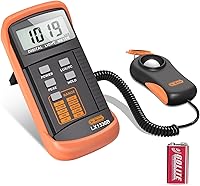
Landtek combines PAR measurement with a lux meter, which can be handy if you also want a visible brightness reading. It has a stated PAR range of 0–5000 μmol/m²/sec and measures lux from 0.1 to 200,000.
The meter stores up to 100 readings across 4 sets, with minimum, maximum and average values calculated automatically. A HOLD function freezes a screen reading, and a threaded mount can attach to a tripod or selfie stick.
Its published PAR range appears in more than one form, so check the unit details before relying on the upper limit for a particular light. It also does not break down PAR into blue, green and red components.
Choose Landtek if having both PAR and lux readings in one handheld tool suits your checks. For a grower who needs color breakdown or mapping, VABIRA or the AH-Quantuv offers more relevant features.
What should you compare in an Apogee PPFD meter?
Compare wavelength range, measurement range, repeatability features and any extra data tools you’ll use. The right combination depends on whether you need a basic canopy reading, a light map, spectrum details or a daily total.
Does wavelength range matter in a PPFD meter?
Yes, wavelength range tells you which light the meter is designed to measure. Most plant PAR readings focus on 400–700 nm, while the AquaHorti AH-Quantuv extends its PAR range to 750 nm and also measures UVA from 320–400 nm.
The range alone does not tell you how the meter handles every grow light. Look for details that match your light source and the type of measurement you need.
Is a higher measurement range always better?
A higher maximum range can be useful when measuring intense light, but it does not by itself tell you which meter is best. DANOPLUS and Landtek state ranges up to 5000 μmol/m²/sec, while VidalKraft states a maximum of 4000 μmol/m²/sec.
Consider the light intensity you expect at the sensor position. Use the meter within its stated range and keep the sensor position consistent when comparing readings.
Do you need spectrum breakdown or grid mapping?
Choose spectrum breakdown if you want to see separate blue, green and red PAR contributions. Choose grid mapping if you want to compare PPFD at multiple points and assess how evenly light reaches the area.
The AquaHorti AH-Quantuv and VABIRA offer RGB breakdowns, while VABIRA also describes grid mapping and uniformity analysis. For cannabis-specific options, see our guide to the best PPFD meter for cannabis.
Should you track DLI as well as PPFD?
DLI is useful when you want a daily total rather than a momentary reading. VidalKraft includes a DLI function, while other meters here focus on PAR or PPFD readings and saved values.
A light schedule affects the amount of light accumulated through the day. Compare the daily total with guidance suited to your crop and growth stage, and keep light distance and duration consistent during comparisons.
How do you take useful PPFD readings?
Take readings at the plant canopy and repeat them at several points under the light. A consistent sensor height and orientation make comparisons more useful than changing position or angle between checks.
Map the center, edges and any areas where plants grow at different heights. Record the readings before adjusting a fixture, then measure again under the same conditions to see how the distribution changed.
A meter reading can also help guide fixture height, but plants and lights differ. Use our guide to grow light distance from plants alongside the light maker’s recommendations for the plant stage.
Which Apogee PPFD meter alternative should you choose?
Choose the AquaHorti AH-Quantuv if you want UVA and separate blue, green and red PAR readings. Pick VABIRA for grid mapping, DANOPLUS for stored spot checks, or VidalKraft when DLI is useful to your routine.
If you want a broader comparison beyond these Apogee alternatives, read our roundup of the best PAR light meters for plants. To manage other parts of a hydroponic setup, see whether you need a pH meter for hydroponics and compare our picks for the best moisture meter for indoor plants.
Our top 3 picks at a glance
-
1
Best for saved spot checks
DANOPLUS Quantum PAR Meter Full-Spectrum High Precision
9.6/10 our score
See it on Amazon -
2
Best for spectrum breakdown
AquaHorti AH-Quantuv PAR Meter for Grow Lights
9.5/10 our score
See it on Amazon -
3
Best for mapped grow areas
VABIRA VBR-100 Quantum PAR Meter 6000umol/
9.4/10 our score
See it on Amazon
Frequently asked questions
What does a PPFD meter measure?
A PPFD meter measures photosynthetic photon flux density, or the amount of photosynthetically active light reaching a surface each second. Readings are usually reported in μmol/m²/sec.
Take readings at plant canopy height and across several spots to see how evenly light reaches the growing area.
Are these Apogee PPFD meters?
These are alternatives to Apogee meters, not Apogee-branded products. They offer different combinations of PAR measurement, spectrum breakdown, UVA readings, data logging and mapping.
Compare the measurement range and features you need with the requirements of your grow setup before choosing.
Should a grow light meter measure UVA?
UVA measurement can help you check whether a light emits ultraviolet A in addition to PAR. The AquaHorti AH-Quantuv and AH-Reef measure UVA, while the other picks here focus on PAR or PPFD features.
Choose UVA measurement only if it answers a specific question about your light.
How many spots should I measure under a grow light?
Measure multiple points across the plant canopy, including the center and edges. A grid gives you a clearer view of hotspots and weaker zones than one reading at the center.
Keep sensor height and orientation consistent as you compare positions.
Can a PPFD meter tell me how far to hang a grow light?
A PPFD meter can show how light intensity changes with distance, but the right hanging height depends on the light and your plants. Take readings at canopy level, then compare them with the light maker's guidance for the growth stage.
Our guide explains how far a grow light should be from plants.