What Is PPFD in Grow Lights?
PPFD in grow lights means photosynthetic photon flux density, the amount of plant-usable light hitting a surface each second. It is measured in micromoles per square meter per second (μmol/m²/s) and tells you how much light your plants can actually use.
On this page (10 sections)
- What is PPFD in grow lights and why does it matter?
- How is PPFD different from lux and lumens?
- How much grow light do plants need?
- How do you measure PPFD at home?
- How do distance and height change PPFD?
- How do you compare fixtures using PPFD maps?
- Which meter fits your needs?
- What is the best grow light for indoor plants when PPFD is part of the choice?
- How do you use PPFD in a daily setup routine?
- What is PPFD in grow lights, in short?
PPFD in grow lights means photosynthetic photon flux density, the amount of plant-usable light hitting a surface each second. It is measured in micromoles per square meter per second (μmol/m²/s) and tells you how much light your plants can actually use.
Think of it as a count of useful light particles, not brightness to your eyes. A lamp can look bright and still deliver light your plants cannot use well.
What is PPFD in grow lights and why does it matter?
PPFD counts photons in the 400 to 700 nanometer range that reach a surface each second. That range is called PAR, and plants use photons in it for photosynthesis.
Watts do not tell the same story. Wattage describes power used, not light delivered to your plants.
Two fixtures with the same wattage can have different efficiency, different spectra, and different PPFD at the same distance.
Lux and lumens also measure light for human eyes. They weight green light heavily because people see it best, but plants use a wider band.
That is why a lux reading can mislead you when you compare grow lights with different colors.
How is PPFD different from lux and lumens?
PPFD measures plant-usable light, while lux and lumens measure light as people see it. Lumens describe total light output from a source.
Lux describes light spread over a surface as your eyes would judge it.
Growers use PPFD because it matches how plants absorb light. A red-heavy lamp may look dimmer to you but score well for plants.
A white lamp may look bright but waste more output outside the useful range.
You can still use a lux meter for rough checks in a room. You should not use it to rank grow lights against each other.
For that comparison, you need a PAR or PPFD reading.
How do you read PPFD in grow light charts?
A grow light chart usually shows PPFD at set distances from the fixture. Look for the height, the size of the test area, and whether the number is a center reading or an average.
A center reading at 12 inches tells you little about the corners of a 4 by 4 foot tent.
Coverage maps show PPFD across a grid, which is more useful than a single peak number. A broad, even map helps you place plants without guessing.
A narrow peak with weak edges can leave half your canopy in low light.
How much grow light do plants need?
There is no single PPFD number that suits every plant and stage.
Seedlings, leafy greens, houseplants, and fruiting plants need different levels, and needs rise as plants grow taller and canopies thicken. Shade-tolerant houseplants do well with modest light, leafy crops need consistent light, and flowering plants usually need the most.
Hours matter too: lower PPFD for longer can equal higher PPFD for shorter. Stretching may mean too little light, bleaching may mean excess light or heat.
Our guide to can grow lights burn plants helps you tell them apart.
How do you measure PPFD at home?
You measure PPFD at canopy height, with the sensor facing the light and the grow light on. Take readings at the center and several spots, and note height and position so you can repeat the check.
Hold the sensor level and keep your body from blocking the light. Wait for the reading to settle and check for shadows.
A phone app gives only a rough idea. Our roundup of the best par light meter for plants explains what to look for in a dedicated meter.
The DANOPLUS meter covers the 400 to 700 nanometer PAR band with a tolerance of plus or minus 10 nanometers. It can store up to 100 measured values and show the last four on a real-time display.
That record helps you track changes after you move a light or change its height.
What should you check before you trust a reading?
Check that the sensor is clean, level, and not in shadow. Check that the light has warmed up and that no part of your body blocks the beam.
Take more than one reading at each spot, since a steady number is easier to trust than a jumping one.
If readings vary a lot, look for flicker, movement, or a sensor that is not seated flat.
How do distance and height change PPFD?
PPFD drops fast as you move a plant away from the light. A small change in height can change the reading at the canopy by a large amount.
That is why setup advice gives distance ranges instead of one fixed number.
Lowering a light raises PPFD but can also raise heat at the leaves. Raising a light lowers PPFD and spreads it over a wider area.
The best height balances intensity, coverage, and heat for your crop.
Our guide to how far should a grow light be from plants walks through distance by plant type. Use PPFD readings to fine-tune after you set a starting height.
How do you compare fixtures using PPFD maps?
Compare fixtures at the same height, over the same area, and with the same method. A wider map with a lower average may suit you better than a high center peak, so check the edges, not just the middle.
Check how the maker measured the map. Some charts use a small test space, some a larger one, and some show only the center.
A chart without height or area is hard to use. Match the fixture to your canopy width, as our guide to how to choose the right grow light for your plants explains.
What does spectrum have to do with PPFD?
PPFD counts photons across the full PAR band, but plants do not use every color in the same way. Blue light supports compact early growth, and red light drives growth and flowering responses.
A PPFD number alone does not show that color balance.
Some meters break PAR down by color, which helps you judge spectrum as well as total light. Two lamps can share a PPFD score and still affect growth differently.
The AquaHorti meter measures PAR from 400 to 750 nanometers and UVA from 320 to 400 nanometers. It displays blue, green, and red PAR separately and can record up to 100 measurements for mapping light distribution.
That helps you see both intensity and color mix across your grow area.
Which meter fits your needs?
The right meter depends on whether you need a simple lux check or a true PPFD reading. A lux meter suits rough room checks.
A PAR meter suits anyone comparing grow lights or tuning a setup for a crop.
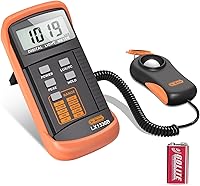
The Dr.meter meter toggles between FC and LUX and reads up to 200,000 lux. It has a PEAK button that locks in the highest pulse value and a low battery alert.
It weighs 12 ounces and runs on one 9V battery that is included.
That tool helps you check general light in a room or near a window. It does not measure PPFD, so it cannot rank two grow lights the way a PAR meter can.
Use it as a backup check, not as your main plant-light tool.
For most growers, a PAR meter is the better first purchase. Our picks for the best PPFD meter for cannabis focus on the needs of high-light crops.
What is the best grow light for indoor plants when PPFD is part of the choice?
The best grow light delivers enough PPFD across your full canopy at a safe height. It should cover your footprint without weak corners and without forcing you to hang it too close.
Efficiency matters, but coverage matters just as much.
Look for a fixture with a clear PPFD map at a height you can actually use. Check the spectrum for your growth stage and crop type.
Check heat output, because a perfect PPFD score is not useful if leaves cook at that height.
Our guide to what is the best grow light for indoor plants covers fixture types and sizing. Read it with a PPFD map in hand.
How do you use PPFD in a daily setup routine?
Start by setting the height from maker guidance for your plant type. Measure PPFD at canopy level in a grid across the grow area.
Adjust height or add a fixture if the edges fall well below the center.
Re-check after plants grow taller, after you rearrange pots, and after you change a timer. A setup that worked for seedlings may give too little light to mature plants.
Small height changes can fix a weak reading without buying new gear.
Keep a simple log with date, height, and readings at each spot. That log shows whether a change helped.
It also helps you spot a failing lamp before growth drops.
What is PPFD in grow lights, in short?
What is PPFD in grow lights comes down to a direct measure of plant-usable light at the surface where your plants grow. Use it to compare fixtures, set height, and check coverage instead of relying on watts or brightness.
Pick a PAR meter if you want true PPFD readings. Pick a lux meter only for rough room checks.
Then match the fixture, height, and map to your crop and space.
Frequently asked questions
What is PPFD in grow lights in simple words?
PPFD is the amount of light between 400 and 700 nanometers that lands on a surface each second. Plants use that range for photosynthesis, so PPFD is a better guide than brightness to a human eye.
Higher PPFD usually means more usable light, up to the point where a plant can no longer use it well.
How much PPFD do plants need?
Needs vary by plant type and growth stage, so check the needs for your crop and stage rather than using one number for all plants. Seedlings often need less than mature, fruiting plants, and shade lovers need less than sun lovers.
A meter helps you match the level at the canopy instead of guessing from watts.
Is PPFD the same as PAR?
They are closely related but not identical terms. PAR describes the waveband of light plants use, while PPFD measures how many photons in that band hit a surface per second.
Most grow light charts and meters use the two terms together for the same practical purpose.
Can I convert lux to PPFD exactly?
No, a conversion depends on the light spectrum, so the same lux can mean a different PPFD with different lights. White LEDs, red LEDs, and sunlight spread energy across wavelengths in different ways.
Use a meter that measures PAR or PPFD directly when you compare grow lights.