9 Best PAR Light Meters for Plants (November 2026)
The best PAR light meters for plants include the Dr.meter Digital Illuminance Light Meter 0-200 for visible brightness checks, the DANOPLUS Quantum PAR Meter Full-Spectrum High Precision for saved PPFD readings, and the AquaHorti AH-Quantuv PAR Meter for Grow Lights for spectrum breakdown.
On this page (7 sections)
A PAR meter that reports PPFD is the right tool for measuring usable plant light and comparing grow light coverage. DANOPLUS is the best all-around pick here for direct PPFD readings and saved values, while AquaHorti adds color-band and UVA information.
Lux meters measure brightness as people see it. They can help compare similar white lights, but they don't directly tell you how much plant-usable light reaches the leaves.
Our picks at a glance
-
1
 Best for visible brightness checks
Dr.meter Digital Illuminance Light Meter 0-200
9.7/10 our score
See it on Amazon -
2
 Best for saved PPFD readings
DANOPLUS Quantum PAR Meter Full-Spectrum High Precision
9.6/10 our score
See it on Amazon -
3
 Best for spectrum breakdown
AquaHorti AH-Quantuv PAR Meter for Grow Lights
9.5/10 our score
See it on Amazon
- 4
 Check it
Soonkoda Digital Illuminance Light Meter Tester
Best for simple lux and FC checks - 5
 Check it
Mcbazel Digital Illuminance Light Meter
Best for visible-light logging - 6
 Check it
Gain Express Quantum PAR Meter for LED Grow
Best for area averages - 7
 Check it
EvoDevice EVO-20 DLI Light Meter
Best for daily sunlight totals - 8
 Check it
LIFEES Grow Light Meter for Plants
Best for quick PPFD checks - 9
 Check it
BTMETER Digital Illuminance Light Meter
Best for angled lux readings
How we chose PAR light meters for plants
The best PAR light meter for plants should match the reading you need: instant PPFD, a spectrum breakdown, or accumulated daily light. We compared the stated measurement types, ranges, recording features and practical limits for each pick.
A lux or foot-candle meter can still help with room brightness. It should not be treated as a substitute for a PAR meter when you need to compare colored grow lights or estimate PPFD.
Our score weighs specs and features against what you need from a plant light meter. The roundup includes both quantum PAR meters and illuminance meters, with their different uses made clear.
| Product | Best for | Measurement | Response | Power | Our score |
|---|---|---|---|---|---|
| Dr.meter Digital Illuminance Light Meter 0-200 | visible brightness checks | Illuminance in lux or foot-candles | 2 readings per second | 1 included 9V battery | 9.7 |
| DANOPLUS Quantum PAR Meter Full-Spectrum High Precision | saved PPFD readings | PPFD, 0–5000 μmol/m²/s | 9.6 | ||
| AquaHorti AH-Quantuv PAR Meter for Grow Lights | spectrum breakdown | PAR 400–750 nm and UVA 320–400 nm | 9.5 | ||
| Soonkoda Digital Illuminance Light Meter Tester | simple lux and FC checks | Visible brightness, up to 200,000 lux | 3 included AAA batteries | 9.4 | |
| Mcbazel Digital Illuminance Light Meter | visible-light logging | Illuminance up to 200,000 lux | 3 AAA batteries, not included | 9.0 | |
| Gain Express Quantum PAR Meter for LED Grow | area averages | PPFD, 0–5000 μmol/m²/s | 8.7 | ||
| EvoDevice EVO-20 DLI Light Meter | daily sunlight totals | Daily Light Integral (DLI) | 2 included AAA batteries | 8.5 | |
| LIFEES Grow Light Meter for Plants | quick PPFD checks | PPFD, 400–700 nm | 8.2 | ||
| BTMETER Digital Illuminance Light Meter | angled lux readings | Illuminance in lux or foot-candles | 2–3 samples per second | 8.0 |
Which PAR light meters are worth considering?
DANOPLUS is the best fit for most growers who want PPFD values and saved measurements. Choose a more specialized meter if you need color-band information, daily totals or basic visible-brightness checks.
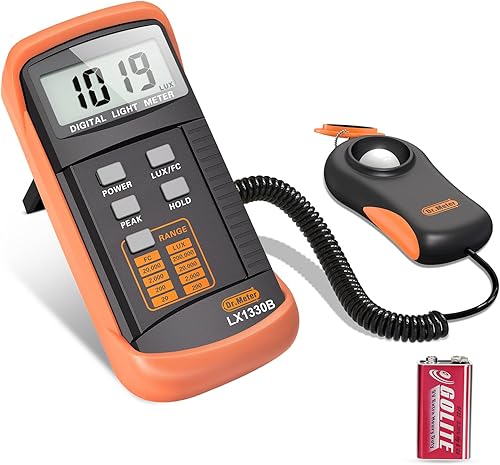
Dr.meter Digital Illuminance Light Meter 0-200: Best for visible brightness checks
- Measures illuminance in lux or foot-candles
- Readings twice per second
- Peak value hold
A straightforward option for comparing visible brightness in a room or outdoors. It measures lux and foot-candles, not PPFD.
Pros
- Switches between lux and foot-candles
- Peak reading function
- Low-battery alert
Cons
- Does not measure PAR or PPFD
- Not a direct measure of plant-usable light
Dr.meter is an illuminance meter, so it measures visible brightness in lux or foot-candles rather than PAR or PPFD. That distinction matters: a high lux reading cannot tell you directly how many photons in the PAR range reach a plant.
Its readings update twice per second, and the PEAK button holds the highest brief value. The low-battery alert is useful if the meter stays in your gardening supplies between light checks.
Use it to compare the brightness of similar white light sources or to check daylight around a room. For light placement, pair measurements with the guidance in How Far Should a Grow Light Be from Plants?.
Choose Dr.meter when you need a simple lux or foot-candle check. If your goal is to compare PPFD across a grow-light footprint, pick one of the quantum meters below.
DANOPLUS Quantum PAR Meter Full-Spectrum High Precision: Best for saved PPFD readings
- Measures 0–5000 μmol/m²/s
- 400–700 nm range
- Stores up to 100 readings
- Tripod socket
This quantum PAR meter gives a direct PPFD value and can store readings for later comparison. A tripod socket helps hold its position during a light map.
Pros
- Measures PPFD in the PAR waveband
- Stores up to 100 readings
- Tripod socket
Cons
- Tripod is not included
- No spectrum breakdown by color
DANOPLUS measures PPFD from 0 to 5000 μmol/m²/s in the 400–700 nm waveband. That makes it a more direct match than a lux meter for comparing plant-usable light at different points beneath a grow light.
It can store up to 100 readings and show the four most recent values. The tripod socket gives you the option to hold the meter in place while taking repeatable readings; the tripod is sold separately.
For a basic light map, measure at canopy height in the center and around the edges. Record each position consistently, then use the pattern to spot areas that may need a fixture-height or intensity adjustment.
DANOPLUS is the best overall choice for saved PPFD readings. If you want more detail about individual wavelengths, AquaHorti provides a color-band breakdown instead.
AquaHorti AH-Quantuv PAR Meter for Grow Lights: Best for spectrum breakdown
- Measures PAR and UVA
- Shows blue, green and red PAR
- Records up to 100 PAR readings
- HOLD function
AquaHorti shows PAR by blue, green and red bands, plus UVA irradiance. Its saved readings can help you compare light distribution across a growing area.
Pros
- Separates PAR into color bands
- Measures UVA
- Historical records and HOLD function
Cons
- More display modes to learn
- No stated PPFD range in the specs
AquaHorti measures PAR from 400–750 nm and UVA from 320–400 nm. Its display can also split PAR into blue, green and red contributions, giving you more spectral detail than a single PPFD number.
The recording function stores up to 100 PAR readings for light-distribution mapping. The HOLD function can keep a value on screen while you note it, and the meter uses 2 included AAA batteries.
This extra detail is useful when comparing fixtures or looking at how spectrum varies across a growing area. It doesn't replace a simple coverage map: take readings at consistent positions and height to make comparisons useful.
Choose AquaHorti if spectrum and UVA are part of your decision. For another comparison focused on PPFD tools for a specific crop, see best PPFD meters for cannabis.
Soonkoda Digital Illuminance Light Meter Tester: Best for simple lux and FC checks
- Measures visible brightness up to 200,000 lux
- Switches between lux and foot-candles
- MAX, MIN and HOLD
- Backlit display
This illuminance meter offers lux and foot-candle readings with MAX, MIN and HOLD functions. Use it for visible brightness comparisons, not as a PPFD meter.
Pros
- Wide stated lux range
- MAX, MIN and HOLD functions
- Backlight and auto power off
Cons
- Does not measure PAR or PPFD
- Visible brightness readings can mislead with grow light colors
Soonkoda measures visible brightness up to 200,000 lux and switches between lux and foot-candles. Its MAX, MIN and HOLD functions help you compare or record illuminance at multiple spots.
This is not a quantum PAR meter, so it won't give you PPFD values. Treat it as a basic brightness tool for similar white lights or ordinary room conditions, rather than using lux to rank lights with different spectra.
The backlit display can help when you're taking readings in a dim grow space. Auto power off and a low-battery indicator round out its basic controls.
Pick Soonkoda for straightforward lux and foot-candle readings. If you need plant-light measurements in PPFD, choose DANOPLUS, AquaHorti, Gain Express or LIFEES.
Mcbazel Digital Illuminance Light Meter: Best for visible-light logging
- Measures up to 200,000 lux
- Stores MAX and MIN
- HOLD and backlight
- Auto power off
Mcbazel records current, maximum and minimum visible brightness in lux or foot-candles. Its own guidance says it is not accurate for red or blue LED grow lights or PPFD.
Pros
- HOLD and MAX/MIN functions
- Backlit display
- Clear limits for grow light use
Cons
- Not suitable for PPFD readings
- Batteries are not included
Mcbazel measures visible illuminance up to 200,000 lux, with lux and foot-candle units, MAX/MIN values and a HOLD function. The key limit is clear: its guidance says the meter is not accurate for red or blue LED grow lights or PPFD.
That makes it a poor choice for comparing many modern grow fixtures. It can still suit basic room-brightness checks, as long as you don't use the reading as a measure of plant-usable light.
The meter uses 3 AAA batteries, which are not included. It also has an auto power-off feature and a low-battery indicator.
Choose Mcbazel only if visible brightness is the measurement you need. For a crop-specific comparison of quantum meters, our best Apogee PPFD meters guide can help you compare another group of options.
Gain Express Quantum PAR Meter for LED Grow: Best for area averages
- Measures 0–5000 μmol/m²/s
- 400–700 nm range
- MAX, MIN and average functions
- Stores up to 100 readings
Gain Express combines a PPFD reading with dynamic MAX, MIN and average values as you scan an area. Stored measurements support later comparison.
Pros
- PPFD measurement for the PAR range
- Calculates average, maximum and minimum
- Stores up to 100 readings
Cons
- Requires 2 AAA batteries
- Does not show separate color bands
Gain Express measures PPFD from 0 to 5000 μmol/m²/s across the 400–700 nm range. Its dynamic mode calculates MAX, MIN and average values as you scan an area, then stores up to 100 readings.
That combination suits growers who want a coverage overview instead of a single center-point number. Move the sensor across the area in a consistent pattern, keeping its height and the light setting the same.
The meter uses 2 AAA batteries. Its readings focus on PPFD and do not provide AquaHorti's separate blue, green and red values.
Choose Gain Express if area averages and saved readings matter most. If plants are stretching toward a fixture, use the readings alongside our guide to why plants stretch toward the grow light.
EvoDevice EVO-20 DLI Light Meter: Best for daily sunlight totals
- Classifies daily light as full sun, partial sun, partial shade or shade
- Stores 10 days of DLI history
- Works with sunlight and several grow light types
EVO-20 tracks accumulated daily light and assigns a sunlight category. It builds a DLI reading over time, so it is not for instant PPFD spot checks.
Pros
- Shows DLI in mol/m²/day
- Stores up to 10 days of readings
- Starts accumulating light automatically
Cons
- Not an instant light meter
- Does not provide a spot PPFD reading
EVO-20 measures Daily Light Integral, or DLI, by accumulating light over time. It then classifies a location as full sun, partial sun, partial shade or shade and can store 10 days of readings.
This is useful when deciding where to place a plant based on the light it receives over a whole day. It is not an instant meter, so a blank or unchanged reading at startup is expected while the device accumulates light.
The device can be used with sunlight, LED grow lights, HPS and CMH. It starts accumulating automatically when placed at the spot you want to assess.
Choose EVO-20 to compare daily exposure across locations, not to map instant PPFD beneath a lamp. If your main question is how much light a plant gets at one moment, a quantum PAR meter is a better match.
LIFEES Grow Light Meter for Plants: Best for quick PPFD checks
- Measures PPFD in the 400–700 nm range
- For LED, HPS and full-spectrum lighting
- Sensor is not waterproof
LIFEES provides instant PPFD readings for common grow light setups. Its simple approach suits spot checks, but keep the sensor dry.
Pros
- Measures plant-useful PAR as PPFD
- Works with LED, HPS and full-spectrum lights
- 2-year service included
Cons
- Sensor is not waterproof
- No stated storage or mapping features
LIFEES measures PPFD in the 400–700 nm range and is described for LED, HPS and full-spectrum lighting systems. Its simple instant-reading approach suits growers who want a direct number without a focus on saved maps or spectrum bands.
The sensor is not waterproof, so keep it away from splashes and nutrient solution. The product includes 2-year service, which may matter if you plan to use the meter regularly.
To compare coverage, take readings at the center and several points around the canopy rather than relying on one spot. Keep the measurement height consistent when you compare fixture settings or placement.
Pick LIFEES for simple PPFD spot checks. If you also use a separate moisture tool to manage plant care, see our best moisture meter for indoor plants.
BTMETER Digital Illuminance Light Meter: Best for angled lux readings
- Measures lux and foot-candles
- Sensor rotates 270 degrees
- Stores 33 sets of readings
BTMETER makes it easier to point the sensor at lights from different angles and stores 33 readings. It measures illuminance, not PPFD.
Pros
- Rotating sensor
- Stores 33 readings
- Fast sampling
Cons
- Does not measure PAR or PPFD
- Lux is not a reliable comparison across different grow light spectra
BTMETER measures illuminance in lux or foot-candles, with a sensor that rotates 270 degrees. It can store 33 sets of readings, which may help when checking brightness from different angles.
Like other lux meters in this roundup, it does not directly measure PPFD. Its broad stated measurement range and quick sampling are useful for visible-light checks, but they don't make it suitable for comparing different grow-light spectra.
The rotating sensor can make it easier to point toward a fixture while keeping the display in view. Use it for basic illuminance tasks, not for a plant-light map based on PPFD.
BTMETER is best when sensor angle and stored lux readings matter. For grow light coverage, use a PAR meter that reports PPFD instead.
How do you choose a PAR meter for a grow light?
Choose a meter that reports PPFD if you want to compare plant-usable light at the canopy. Lux and foot-candle meters measure visible brightness and can mislead when grow lights have different color mixes.
Look for a stated PAR range and a PPFD unit such as μmol/m²/s. A saved-reading feature can help with mapping, while a DLI meter answers a different question by tracking total light over time.
For a useful coverage check, measure at the plant canopy, not at the floor or fixture. Take several readings across the growing area, and keep the height and lamp setting consistent.
Can lux readings compare grow lights?
Lux readings can compare similar white light sources, but they are not a dependable way to compare grow lights with different spectra. Lux is weighted to human vision, while PPFD measures photons in the photosynthetically active range.
This is why a lux meter such as Dr.meter, Soonkoda or BTMETER may help with room brightness but not answer how evenly a grow light delivers PAR. Mcbazel's guidance specifically warns against using it for red or blue LED grow lights or PPFD.
What is the difference between PPFD and DLI?
PPFD is an instant measure of PAR photons reaching a surface each second, while DLI is the total light accumulated over a day. A PPFD meter helps you map a fixture at one time; a DLI meter helps compare daily exposure.
EVO-20 is designed to build a DLI reading gradually. For spot checks and coverage maps, choose a quantum PAR meter that displays PPFD.
How do you map grow light coverage?
Map coverage by measuring PPFD at the center and several points near the edges of the plant canopy. Keep sensor height and light settings the same at each point so the readings are comparable.
A meter with saved values, such as DANOPLUS or AquaHorti, can make it easier to review readings later. If you change the light's height or intensity, repeat the same map to see how the coverage pattern changes.
Which PAR light meter should you choose?
Choose DANOPLUS for saved PPFD readings and straightforward coverage checks. Pick AquaHorti if you want separate color-band and UVA information, or EVO-20 if daily accumulated light is your main question.
A lux meter is enough for basic visible-brightness comparisons under similar white lights. For grow-light coverage and plant-usable light, choose a meter that reports PPFD, then take readings across the canopy rather than at one point.
Our top 3 picks at a glance
-
1
Best for visible brightness checks
Dr.meter Digital Illuminance Light Meter 0-200
9.7/10 our score
See it on Amazon -
2
Best for saved PPFD readings
DANOPLUS Quantum PAR Meter Full-Spectrum High Precision
9.6/10 our score
See it on Amazon -
3
Best for spectrum breakdown
AquaHorti AH-Quantuv PAR Meter for Grow Lights
9.5/10 our score
See it on Amazon
Frequently asked questions
What is the best PAR light meter for plants?
The DANOPLUS Quantum PAR Meter is a strong fit for growers who want PPFD readings and saved measurements. It measures from 0 to 5000 μmol/m²/s across 400–700 nm and stores up to 100 values.
Choose AquaHorti if you want separate blue, green and red PAR readings, or LIFEES for a simpler instant PPFD check.
Is a lux meter the same as a PAR meter?
No. A lux meter measures visible brightness as the human eye sees it, while a PAR meter measures light in a waveband used for photosynthesis, often reported as PPFD.
Lux can help compare similar white lights, but it can give a poor comparison between lights with different colors or spectra.
What does PPFD mean on a plant light meter?
PPFD means photosynthetic photon flux density. It describes the number of PAR photons reaching a surface each second, commonly shown in μmol/m²/s.
Take readings at the plant canopy and at several points, since a single center reading won't show how evenly a fixture covers the growing area.
Should I choose a PAR meter or a DLI meter?
Choose a PAR meter for an instant PPFD reading at a place and time. Choose a DLI meter when you want to track the total light received over a full day.
EVO-20 accumulates light over time and stores up to 10 days of DLI history, so it does not replace a spot-reading meter.
How do I map grow light coverage?
Keep the sensor at canopy height and take readings at the center and several points toward the edges. Use the same height and light setting for each reading so the values can be compared.
A meter with saved readings, such as DANOPLUS or AquaHorti, can make it easier to review the pattern afterward.