9 Best Temperature and Humidity Controllers (November 2026)
The best temperature and humidity controllers for grow tents include the Inkbird Temperature and Humidity Controller ITC-608T Pre-Wired for full climate control in one unit, the VIVOSUN Humidity Controller for humidity-first grow tents, and the Inkbird Humidity Controller IHC200 Humidistat for Mushroom for simple humidity switching.
On this page (7 sections)
- The best temperature and humidity controllers for grow tents
- How the best temperature and humidity controller picks compare
- Can one controller run both a humidifier and a dehumidifier?
- What range and accuracy should you look for?
- Does app control beat button control?
- How should you set up the probe and outlets in a tent?
- Which controller should you buy for your grow tent?
The best temperature and humidity controller for most grow tents is the Inkbird Temperature and Humidity Controller ITC-608T Pre-Wired, with a score of 9.7.
It controls temperature and humidity together, handles up to 1800W, and saves your settings if power cuts out.
A temperature and humidity controller earns its place by switching your gear on and off at the right moment.
You set a target, the sensor reads the tent, and the outlets run a heater, cooler, humidifier or dehumidifier as needed.
That saves you from checking the tent through the night.
Our score weighs specs, features and buyer feedback against what you're shopping for.
Higher scores here go to units that control both readings, handle more wattage, and protect cooling devices with a compressor delay.
Start with your tent's biggest swing.
If temperature swings drive your problems, a combined unit helps most.
If humidity is the fight, a humidity-first controller may serve you better, and our guide to grow tent equipment helps you plan the whole setup first.
Our picks at a glance
-
1
 Best for full climate control in one unit
Inkbird Temperature and Humidity Controller ITC-608T Pre-Wired
9.7/10 our score
See it on Amazon -
2

-
3
 Best for simple humidity switching
Inkbird Humidity Controller IHC200 Humidistat for Mushroom
9.5/10 our score
See it on Amazon
- 4
 Check it
DIGITEN DHTC-1011 Temperature and Humidity Controller Outlet
Best for wide temperature ranges - 5
 Check it
DIGITEN Humidity Controller with Temperature Display
Best for humidity control with temperature monitoring - 6
 Best for app and schedule programmingCheck it
- 7Check it
SENSTREE Temperature & Humidity Controller
Best for budget dual stage control - 8
 Check it
Inkbird ITC-308 Temperature Controller with IHC-200 Humidity
Best for separate temperature and humidity units - 9
 Check it
Pymeter Temperature and Humidity Controller Reptile Mushroom
Best for compact all-in-one sensing
The best temperature and humidity controllers for grow tents
The Inkbird ITC-608T is the strongest all-round pick for combined control.
The models below trade temperature control, app features or wattage for simpler humidity-only setups or lower cost.
Inkbird Temperature and Humidity Controller ITC-608T Pre-Wired: Best for full climate control in one unit
- Dual stage temperature and humidity control
- 120VAC 15A 1800W max loading
- Temperature range -40 to 212 F
- Humidity range 5 to 99% RH
- Calibration, compressor delay and saved settings
- ETL listed
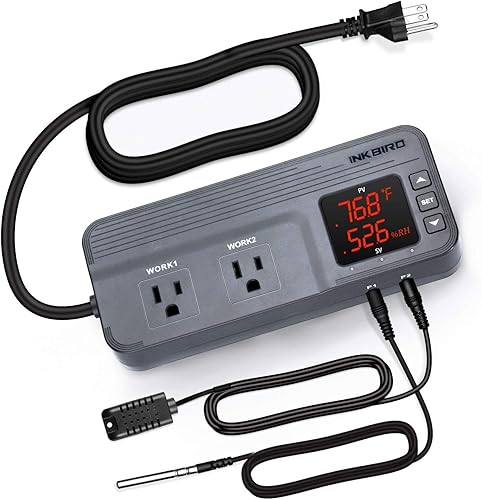
One pre-wired unit with separate temperature and humidity probes runs a heater or cooler on one outlet and a humidifier or dehumidifier on the other.
Pros
- Controls temperature and humidity together
- High 1800W max loading
- Calibration and compressor delay
- Saves settings after power loss
Cons
- Button setup takes longer than app setup
- Two probes need careful placement
This Inkbird suits growers who want one unit to handle the full climate job.
WORK1 runs a heating or cooling device while WORK2 runs a humidifier or dehumidifier, so both readings get an outlet.
The max loading is 120 Volt, 15 Amps and 1800 Watts, the highest here.
That gives you room for larger heaters or dehumidifiers, but add up your devices and stay under the limit.
Temperature runs from minus 40 to 212 Fahrenheit degrees and humidity from 5 to 99% RH.
That span covers cold nights, warm afternoons and high humidity spells without changing units.
Inkbird says the unit is ETL listed and supports calibration in Centigrade or Fahrenheit.
A compressor delay protects cooling devices that should not restart too fast, and settings save automatically.
The trade-off is setup time.
Separate temperature and humidity probes need careful placement, and button control takes longer than app programming.
For full control in one box, it is hard to beat here.
VIVOSUN Humidity Controller: Best for humidity-first grow tents
- Dual relay outputs for humidifier and dehumidifier
- 1200W output
- Humidity range 5% to 99% RH
- Accuracy plus or minus 3% RH
- Dual LED displays
- High and low humidity alarms
A humidity controller with separate outputs for a humidifier and a dehumidifier, plus alarms and a display that shows measured and set humidity at once.
Pros
- Runs humidifier and dehumidifier together
- Alarms for high, low and sensor faults
- Calibration for accuracy
- Large dual LED screens
Cons
- Speed: no temperature control output
- 1200W output is lower than the top pick
This VIVOSUN suits growers whose main fight is humidity.
Dual relay outputs run a humidifier and a dehumidifier at the same time, so the unit can add or remove moisture as the tent drifts.
It controls humidity from 5% to 99% RH with accuracy of plus or minus 3% RH.
Calibration helps you correct a sensor that reads a little high or low against a trusted meter.
VIVOSUN says it has visual and audible high and low humidity alarms plus a sensor fault alarm.
Those alerts help when a probe slips or humidity climbs past your target while you are away.
The display shows measured and set humidity together on large dual LED screens.
A 5.9ft power cord and hanging tab make setup simple, and the 16AWG cord with a 20A relay reduces overload risk.
The trade-off is clear: this is humidity only, with no temperature control output.
If your tent temperature is stable, that focus is a plus.
If nights run cold, pair it with a separate thermostat.
Inkbird Humidity Controller IHC200 Humidistat for Mushroom: Best for simple humidity switching
- Humidity range 5 to 99.99% RH
- Accuracy plus or minus 3% RH
- Automatic humidify and dehumidify switching
- Calibration support
- Pre-wired dual stage outlets
- Digital display
A straightforward humidistat that switches between a humidifier and a dehumidifier automatically, with calibration to fine tune the reading.
Pros
- Simple automatic switching
- Calibration support
- Fits mushroom, grow tent and greenhouse use
- Digital readout
Cons
- No temperature control output
- Resolution is 1% RH
This Inkbird suits growers who want simple humidity switching without extra menus.
It switches between humidification and dehumidification automatically, so one unit can run both a humidifier and a dehumidifier.
The humidity range is 5 to 99.99% RH with accuracy of plus or minus 3% RH and 1% RH resolution.
That is precise enough for most tent targets, where a few percent either way rarely matters to plants.
Inkbird says it works in a mushroom room, grow tent or greenhouse, and as a reptile humidity controller.
Calibration support lets you fine tune the reading, which helps when two meters disagree.
The package includes a control panel, 2 sockets and a humidity probe.
Power output is max 10A at 100V to 240V AC, so check your humidifier and dehumidifier draw before you plug both in.
The trade-off is temperature: this unit controls humidity only.
If you also need night heat or day cooling, choose a combined controller instead.
For humidity alone, it is a proven simple pick.
DIGITEN DHTC-1011 Temperature and Humidity Controller Outlet: Best for wide temperature ranges
- 2-in-1 temperature and humidity sensor
- Temperature range -40 to 248 F
- Humidity range 1%RH to 100%RH
- Dual relay output
- Large LCD screen with 3 buttons
- Calibration, compressor delay and saved settings
A plug and play dual relay controller with a wide temperature range and a single sensor that reads both temperature and humidity.
Pros
- Widest temperature range here
- One 2-in-1 sensor
- High and low alarms
- Saves settings after power loss
Cons
- Humidity range reaches 100% RH but accuracy is not stated here
- Button-only setup
This DIGITEN suits growers who need a wide temperature span in one plug and play unit.
The temperature range runs from -40 to 248 F, wider than most picks here, and humidity runs 1%RH to 100%RH.
A 2-in-1 sensor reads both temperature and humidity, so you place one probe instead of two.
Dual relay output lets you control temperature and humidity equipment at the same time.
The large LCD screen with a simple 3-button design keeps setup straightforward.
DIGITEN says it supports calibration, compressor delay and saving reset values, so settings survive a power outage.
High or low temperature and humidity alarms add a safety net.
Centigrade or Fahrenheit display lets you set the unit in the scale you think in, which reduces setup mistakes.
The trade-off is stated detail.
Humidity accuracy is not given here, unlike several picks with plus or minus 3% RH.
If accuracy proof matters to you, compare it with the Inkbird or VIVOSUN first.
DIGITEN Humidity Controller with Temperature Display: Best for humidity control with temperature monitoring
- Humidity range 5% to 99% RH
- Accuracy plus or minus 3% RH
- Temperature display only, no temperature control
- Dual stage humidifier and dehumidifier outlet
- Plug and play, non-programmable
- Calibration and compressor delay
Controls a humidifier and dehumidifier while showing temperature, so you can watch both readings without a second meter.
Pros
- Shows temperature while controlling humidity
- Simple plug and play setup
- Swiss-imported humidity sensor claim
- Calibration support
Cons
- Cannot control temperature
- Humidifier needs automatic restart
- Non-programmable
This DIGITEN suits growers who want humidity control plus a temperature readout.
It controls humidity while displaying temperature, so you can watch both readings on one screen.
The humidity range is 5% to 99% RH with accuracy to within plus or minus 3% RH.
DIGITEN says a high accuracy sensor and digital signal chip help hold that accuracy.
Setup is plug and play with no complex programming.
You set a humidity level and the controller switches between humidification and dehumidification modes for you.
Note that this unit can only measure temperature, not control it.
It also needs a humidifier with an automatic restart function, so check that detail before you buy.
The trade-off is scope.
There is no temperature outlet for a heater or cooler, and the unit is non-programmable.
If your tent only needs moisture control and a temperature view, it fits well.
AC Infinity Controller: Best for app and schedule programming
- Two outlet devices with independent programming
- Temperature, humidity and VPD triggers
- Timers, cycles and scheduling
- Bluetooth and WiFi app pairing
- Up to 1100W across two outlets
- Notifications and climate data graphs
An app connected controller that programs two outlets separately with temperature, humidity and VPD triggers, timers and schedules.
Pros
- Independent programs for two outlets
- App with notifications and graphs
- VPD triggers
- Schedules and cycles
Cons
- Lowest total wattage here at 1100W
- Needs a phone for advanced programs
This AC Infinity suits growers who want app programming and schedules.
It powers up to two outlet devices with independent programming, so each outlet can run its own rules.
Programs include temperature, humidity and VPD triggers, plus timers, cycles, scheduling and custom buffers.
That VPD trigger is rare here and helps growers who track vapor pressure deficit closely.
You can pair it with the app via Bluetooth or WiFi to access advanced programs, set notifications and view climate data.
Graphs show temperature, humidity and VPD data over time.
The two outlets together support up to 1100W.
That is the lowest total here, so check each device's draw and keep the combined load under the limit.
The trade-off is wattage and phone dependence.
Advanced programs need the app, while simpler button controllers work at the tent.
For schedules and alerts, this is the modern pick.
SENSTREE Temperature & Humidity Controller: Best for budget dual stage control
- Dual relay output for temperature and humidity
- Dual LED screens
- 3-button plug and play design
- Calibration and compressor delay
- High and low value alarms
- Heating and cooling control type
A pre-wired dual stage controller that shows measured and set temperature together, with alarms and calibration for cooling equipment protection.
Pros
- Controls temperature and humidity at once
- Shows measured and set temperature together
- Compressor delay protects cooling devices
- Simple 3-button use
Cons
- Wattage and exact ranges are not stated here
- Button-only setup with no app
This SENSTREE suits budget buyers who want dual stage control on a simple 3-button unit.
Dual relay output controls temperature and humidity at the same time, with a sensor that feeds both functions.
Dual LED screens show measured and set temperature together.
That helps you see the gap between where the tent is and where you set it, without guessing.
SENSTREE says it has temperature calibration and compressor delay to protect cooling equipment.
High and low value alarms add a warning when readings leave your range.
The design is plug and play, and the unit supports Centigrade or Fahrenheit display.
It suits greenhouses, terrariums, fermentation and seed germination, plus grow tents.
The trade-off is stated detail.
Wattage and exact temperature and humidity ranges are not given here, so confirm those details before pairing it with larger gear.
For light-duty use, it is a low cost option.
Inkbird ITC-308 Temperature Controller with IHC-200 Humidity: Best for separate temperature and humidity units
- Temperature controller plus humidity controller in one package
- Two outlets on each unit
- Temperature range -58 to 248 F
- Humidity range 5 to 99.99% RH
- Calibration on both units
- Buzzer alarms for high and low values
Two controllers in one package, so temperature and humidity run on separate units with four outlets in total for more flexible device placement.
Pros
- Four outlets across two units
- Separate placement for each probe
- Calibration on both units
- Buzzer alarms
Cons
- Two units mean more setup
- Takes more space than one combined unit
This Inkbird bundle suits growers who want separate units for temperature and humidity.
It includes a temperature controller and a humidity controller, each with two power outlets.
That gives you four outlets in total.
You can plug heating gear and a ventilation fan into the temperature unit, and a humidifier and dehumidifier into the humidity unit.
Temperature control runs -58 to 248 F with 0.1 degree resolution.
Humidity measures 5 to 99.99% RH and controls 5 to 99% RH with plus or minus 3% RH accuracy.
Both units support calibration, and buzzer alarms warn on high or low temperature or humidity.
Separate probes let you place each sensor where its reading matters most.
The trade-off is space and setup.
Two units mean more cords, more menus and more wall space than one combined controller.
For flexible device placement, that extra footprint buys real freedom.
Pymeter Temperature and Humidity Controller Reptile Mushroom: Best for compact all-in-one sensing
- Controls humidity and temperature at the same time
- Pre-wired dual controlled outlets
- 1200 watts
- All-in-one temperature and humidity sensor
- LCD display
- Programmable
A compact pre-wired controller with an all-in-one sensor and dual outlets for a heater or cooler plus a humidifier or dehumidifier.
Pros
- Controls both readings at once
- Single all-in-one sensor
- 1200 watts
- Compact rectangular shape
Cons
- Fewest stated specs in this group
- No stated calibration or alarm functions
This Pymeter suits growers who want a compact all-in-one sensor design.
It controls humidity and temperature at the same time through pre-wired dual controlled outlets.
The unit uses a temperature and humidity all-in-one sensor, so one probe placement feeds both functions.
That helps in a small tent where probe space is tight.
Wattage is 1200 watts, which fits many small humidifiers and dehumidifiers.
The LCD display shows readings at a glance, and the rectangular shape mounts easily near a tent pole or wall.
Inkbird and VIVOSUN state more detail on calibration, alarms and accuracy.
This Pymeter does not state those functions here, so treat sensor accuracy as unconfirmed and check it against a second meter.
The trade-off is information.
Fewer stated specs make it harder to compare with the top picks.
For a simple dual outlet setup on a budget, it can still do the job.
How the best temperature and humidity controller picks compare
The top picks split into combined controllers, humidity-only controllers and one app-based unit.
Combined models do more jobs, while humidity-only models keep setup simpler.
| Product | Best for | Control type | Max loading | Temperature range | Our score |
|---|---|---|---|---|---|
| Inkbird Temperature and Humidity Controller ITC-608T Pre-Wired | full climate control in one unit | Temperature and humidity, dual stage | 120VAC 15A 1800W | -40 to 212 F | 9.7 |
| VIVOSUN Humidity Controller | humidity-first grow tents | Humidity, dual relay | 9.6 | ||
| Inkbird Humidity Controller IHC200 Humidistat for Mushroom | simple humidity switching | Humidity, dual stage | 9.5 | ||
| DIGITEN DHTC-1011 Temperature and Humidity Controller Outlet | wide temperature ranges | Temperature and humidity, dual relay | -40 to 248 F | 9.4 | |
| DIGITEN Humidity Controller with Temperature Display | humidity control with temperature monitoring | Humidity control, temperature display | 9.0 | ||
| AC Infinity Controller | app and schedule programming | Temperature, humidity, VPD, schedules | 8.6 | ||
| SENSTREE Temperature & Humidity Controller | budget dual stage control | Temperature and humidity, dual relay | 8.4 | ||
| Inkbird ITC-308 Temperature Controller with IHC-200 Humidity | separate temperature and humidity units | Separate temperature and humidity units | -58 to 248 F | 8.3 | |
| Pymeter Temperature and Humidity Controller Reptile Mushroom | compact all-in-one sensing | Temperature and humidity, dual outlets | 7.9 |
We compared these picks by control scope first, then by max wattage, ranges, accuracy, alarms and setup style.
A combined unit scores higher here because most grow tents need both readings controlled.
We checked specs for each model, including ranges, outputs and included probes.
Where a spec was not stated, we treated it as unconfirmed rather than guessing a number.
Buyer feedback helped break ties between similar models.
Units with calibration and compressor delay scored better because those features protect cooling gear and fix sensor drift.
Price tier did not drive the order.
A lower score can still fit your tent if it matches your main problem, such as humidity-only control or app schedules.
Can one controller run both a humidifier and a dehumidifier?
Yes, and dual stage or dual relay models are built for that job.
One outlet runs the humidifier, the other runs the dehumidifier, and the controller switches based on your set point.
Set a differential so the devices do not run together.
For example, a small gap between the humidify trigger and the dehumidify trigger stops constant switching and saves energy.
This setup helps most when humidity swings with lights on and off.
Our guide on how to control humidity in a grow tent walks through those daily swings in more detail.
Humidity-only vs combined control
Humidity-only models like the VIVOSUN and Inkbird IHC200 focus on moisture.
They suit tents where temperature stays stable without help.
Combined models like the Inkbird ITC-608T and DIGITEN DHTC-1011 add a heater or cooler outlet.
That extra outlet matters on cold nights or hot afternoons.
Choose humidity-only if your room and lights already hold temperature.
Choose combined if you have seen both readings drift in the same day.
What range and accuracy should you look for?
Most tents need humidity control from about 40% to 80% RH, so a 5% to 99% RH range covers nearly every target.
Temperature ranges that span below freezing to well above 100 F give you room for seasonal shifts.
Accuracy matters more than range width.
A stated accuracy of plus or minus 3% RH, as on the VIVOSUN and Inkbird IHC200, tells you how far the reading may drift from reality.
Calibration lets you correct that drift.
If your controller reads 3% high against a trusted meter, calibration can bring it closer, which helps keep humidifiers and dehumidifiers from fighting.
Resolution is the smallest step the display shows.
A 1% RH resolution is common and fine for tent targets, where plants respond to trends more than single points.
For temperature targets, check what is the ideal temperature for a grow tent before you set your controller.
A good target first makes the controller's job much easier.
Wattage and outlet count
Add up the watts of every device on each outlet, then stay under the controller's max.
The Inkbird ITC-608T allows 1800W, while the AC Infinity allows 1100W across two outlets.
Two outlets are enough for most tents: one for heat or cool, one for humidify or dehumidify.
Four outlets, as on the Inkbird ITC-308 bundle, help when you also run a fan on a schedule.
If a dehumidifier draws more power than your humidifier, plan the larger device for the outlet with headroom.
An overloaded outlet is a safety risk, not just a nuisance.
Does app control beat button control?
App control wins for schedules, graphs and alerts.
The AC Infinity Controller pairs via Bluetooth or WiFi and can send notifications when readings spike, which helps when you are not beside the tent.
Button control wins for simplicity and reliability.
You can change a set point at the tent in seconds, with no phone, no password and no WiFi needed.
Some growers use both approaches.
A button controller handles daily switching, while a phone meter or app gives a second view of trends and alerts.
Our best humidity controller for grow tent roundup compares humidity-only units in more depth if app features seem unnecessary for your setup.
Compressor delay and saved settings
A compressor delay stops a cooling device from restarting too fast.
That short wait protects compressors in dehumidifiers, fridges and AC units from short cycling.
Saved settings matter after a power outage.
Models that save your set points restart with your targets instead of default values, which can save a crop stage.
Look for both features if you run cooling gear.
The Inkbird ITC-608T, DIGITEN DHTC-1011 and SENSTREE all state calibration and compressor delay.
How should you set up the probe and outlets in a tent?
Place the probe at canopy height, away from direct mist, light and fan airflow.
Air should flow past the sensor so it reads what your plants feel, not a pocket of still air.
Hang the controller where you can see the display without opening the tent often.
Each opening changes humidity and temperature, so a visible display cuts those checks.
Plug the humidifier into the humidify outlet and the dehumidifier into the dehumidify outlet.
Label the cords, because a swapped plug can run the wrong device at the wrong time.
Our grow tent heater and humidifier guide pairs well with this setup, since heater and humidifier choices change how hard your controller works each day.
First week checks
Run the tent empty for a day and watch how often each outlet cycles.
Short cycles suggest your differential is too tight or a device is too strong for the space.
Add plants, then set your target based on growth stage.
Seedlings often need higher humidity, while flowering often needs lower humidity, so adjust the set point as plants grow.
Check the reading against a second meter at the start.
If the offset is consistent, use calibration, then recheck after a few days of normal use.
Which controller should you buy for your grow tent?
Buy the Inkbird ITC-608T if you want one unit for temperature and humidity with the highest wattage here.
It is the best temperature and humidity controller for most tents, as the answer at the top explains.
Buy the VIVOSUN if humidity is your main problem and temperature already stays stable.
Its alarms and dual relay outputs make moisture control simpler.
Buy the AC Infinity if you want app schedules, VPD triggers and notifications.
Accept the lower 1100W total and plan your devices around it.
For moisture gear to pair with any of these, see our best humidifiers for grow tents and best small dehumidifier for grow tent picks.
The right controller plus the right device size keeps cycling smooth and quiet.
Our score weighs specs, features and buyer feedback against what you're shopping for.
Use that score as a starting point, then match the badge and specs to your tent's biggest swing.
Our top 3 picks at a glance
-
1
Best for full climate control in one unit
Inkbird Temperature and Humidity Controller ITC-608T Pre-Wired
9.7/10 our score
See it on Amazon -
2
-
3
Best for simple humidity switching
Inkbird Humidity Controller IHC200 Humidistat for Mushroom
9.5/10 our score
See it on Amazon
Frequently asked questions
What is the best temperature and humidity controller for a grow tent?
For most growers, the Inkbird ITC-608T Pre-Wired is the best temperature and humidity controller because it runs heating or cooling and humidifying or dehumidifying from one unit. Choose a humidity-only model if temperature is already stable, and check max wattage against your devices before you buy.
Can one controller run a humidifier and a dehumidifier at the same time?
Yes. Dual stage and dual relay models have two outlets, so a humidifier runs on one and a dehumidifier runs on the other.
The controller switches between them based on your set humidity and differential.
Set a small gap so the two devices do not fight each other.
Do I need app control or is button control fine?
Button control is fine for a tent beside you, and it works during a WiFi outage. App control helps when you want schedules, graphs or alerts from another room.
The AC Infinity Controller is the app pick here, while the Inkbird and DIGITEN models use buttons.
Where should the sensor probe go in a grow tent?
Place the probe at canopy height, away from direct mist, lights and vents. Air should move past it so it reads the air your plants feel.
Check the reading against a second meter during setup, then use calibration if the offset is consistent.