How to Choose Heating and Cooling for a Grow Tent
Choose grow tent heating and cooling by the lowest and highest temperatures your plants face: use a thermostatic heater for cold periods, controlled ventilation for mild heat, and air conditioning when the room itself stays too warm.
On this page (7 sections)
- What heating and cooling does a grow tent need?
- How do you choose a grow tent heater?
- Is a thermostat important for grow tent heating?
- When does a grow tent need cooling?
- How should heating and cooling work with grow lights?
- How can you set up grow tent heating and cooling safely?
- What is the best grow tent heating and cooling setup?
Choose grow tent heating and cooling by the coldest and hottest conditions around the tent, then match equipment to tent volume, airflow, humidity and electrical safety. A thermostatic heater handles cold periods, while ventilation or air conditioning helps when heat builds faster than the tent can release it.
Start by measuring the temperature at plant height rather than near the floor or ceiling. If the surrounding room is already comfortable, you may need only gentle heat or better air exchange.
Growers often judge a tent from the room thermostat, yet the space inside can behave very differently. Fabric walls, closed doors and lights can trap warmth, while a cold floor or an outside wall can pull heat away from the lower canopy.
That gap matters because plants respond to the air around their leaves, not to a reading taken across the room. A sensor near a heater may feel warm, while the far corner stays cool, and a sensor near the ceiling may miss a cold pocket at plant level.
Tent volume also changes the response. A small tent can warm or cool quickly after a setting changes, while a larger enclosed space may take longer to balance once the lights, fan or heater switch state.
Airflow shapes the result as much as output does. Still air can sit in layers, so one plant may receive warm air while another sits in a stagnant patch, even when the average temperature looks acceptable.
Humidity needs the same attention from the start. Heating usually lowers relative humidity, cooling can raise it, and watering adds moisture that neither a heater nor a fan controls on its own.
Think about the room first, then the tent, then the canopy. That order helps you decide whether the main problem is a cold room, poor air exchange, or a heat source that needs better placement.
Electrical safety belongs in the early plan as well. High power heaters and cooling units need stable placement, clear space around vents, dry cords and easy access to plugs and controls.
For more detailed equipment choices, read our grow tent equipment guide.
What heating and cooling does a grow tent need?
A grow tent usually needs heating when the room becomes too cold and cooling when lights, equipment or outdoor weather push temperatures too high. The right setup keeps temperature changes gradual, with enough airflow to prevent hot or cold pockets.
Separate the problem into 3 parts:
- Heat source: raises the air temperature during cold periods.
- Air movement: spreads warmth and removes stagnant air.
- Heat removal: exhausts warm air or lowers room temperature with cooling equipment.
Measure both the daytime and nighttime temperature. Lights may warm the tent during the day, while the room can cool quickly after lights go off.
A day and night check shows whether heating, cooling or airflow is doing the most work. Without that split, it is easy to add power to a problem that is really about trapped heat or a cold draft.
Humidity matters too. Warm air can show a lower relative humidity reading even when the amount of moisture has not changed.
Cooling may raise relative humidity as air temperature falls, so check both temperature and humidity instead of adjusting only one reading.
That link between temperature and humidity explains why a tent can feel fine at noon and damp at night. Watering, plant transpiration and a closed door add moisture while the air cools and holds less of it.
Air movement helps here by mixing the space and carrying moisture toward an exhaust path. A fan alone cannot remove water from the room, but still air makes readings harder to trust and pockets more likely.
Insulation and placement also affect how hard each part must work. A tent against a cold outside wall or in direct sun faces a different load from one in a stable interior room.
Start with the three functions in order. Set a safe heat source for cold periods, add air movement to spread that heat, and plan heat removal before temperatures climb under lights.
How do you choose a grow tent heater?
Choose a heater with thermostat control, suitable output and safety features, then place it where it cannot contact fabric, foliage, water or loose materials. The heater should warm moving air rather than create a hot spot beside one plant.
A 1500W heater can produce substantial heat in a small enclosure. Use the lowest setting that maintains the target temperature, and watch how quickly the tent warms after the lights turn off.
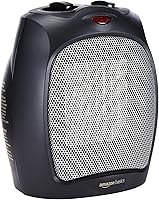
The Amazon Basics Ceramic Space Heater measures 7.52 in deep, 6.34 in wide and 9.45 in high. Its 3 lb portable form can suit a small grow area where floor or tabletop placement leaves safe clearance.
It has a 1500W High setting, a 900W Low setting and a Fan Only mode. The Fan Only mode moves air without adding heat, which can help with circulation during a mild period.
This heater is non-oscillating, so its position affects where warmth travels. Keep it away from humid areas, and don't place it where watering, runoff or mist can reach it.
For a step-by-step setup, see how to heat a grow tent. Insulation can also reduce how often a heater needs to run, so compare the best insulation for grow tents before increasing heater output.
Is a thermostat important for grow tent heating?
A thermostat is useful because it lets you set a temperature instead of relying only on a heater's power level. It does not replace a separate temperature check, since the air around the heater may differ from the air around the plant canopy.
Place the separate sensor at canopy height and away from direct heat. Check it during the coldest part of the night and after the lights have been on long enough to warm the space.
The DREO Space Heater is 6.02 in deep, 6.02 in wide and 10 in high, with a free-standing tower form and a 3 lb weight. Its Power Heat, ECO and Fan Only modes give you more ways to adjust output as conditions change.
The thermostat range runs from 41°F to 95°F in 1°F increments. A remote control, mute setting, child lock and memory function can make adjustments easier when the heater is positioned outside the most convenient reach.
DREO describes the unit as operating at 34 dB and using a brushless DC motor. Those details may suit a grow space near a living area, but quiet operation does not remove the need for safe clearance and regular inspection.
Choose this type of heater when temperature control matters more than the smallest possible footprint. A basic heater may be enough for a small, stable room, while a wider thermostat range helps when nighttime conditions vary.
When does a grow tent need cooling?
A grow tent needs cooling when ventilation cannot remove enough heat to keep the canopy in range. Start with air exchange and light scheduling, then consider air conditioning if the surrounding room stays too warm.
Check these causes before adding a cooling unit:
- Warm air entering from an already hot room.
- Insufficient exhaust or blocked intake openings.
- Heat collecting above the lights.
- A tent positioned in direct sun or beside a heat source.
- Humidity rising when air movement is too low.
Vent warm air out of the tent and bring in cooler air from a clean location. Keep intake and exhaust paths separate enough that the system does not pull its own warm exhaust back inside.
If the room itself is hot, a portable air conditioner may help more than placing a small cooling device inside the tent. It needs a safe exhaust route, space around the cabinet and a suitable electrical connection.
The BLACK+DECKER Portable Air Conditioner measures 14 in deep, 15.3 in wide and 24.8 in high. Its 9,000 BTU cooling output, also described as 5,300 BTU SACC, is intended for room cooling rather than a tiny enclosed tent.
The unit includes an air exhaust hose, hose inlet and outlet adapters, a window casement, a water drain hose, an owner's manual and a full-function remote control. Casters and side handles allow it to move between locations.
Its washable filter needs regular cleaning so dust does not restrict airflow. The unit also has a dehumidifier and fan function, which can help when the room needs moisture removal or air movement without active cooling.
Because this is a room-sized appliance, measure the proposed location before using it near a grow area. A portable AC can be a better fit for cooling the surrounding room than for sitting inside a small tent.
How should heating and cooling work with grow lights?
Lighting and climate equipment should be planned together because lights can add heat even when the room feels cool. Choose the light schedule and exhaust plan before deciding how much heater or cooling capacity you need.
Read how to choose the right grow light for your plants before finalizing the climate setup. A high-output light in a small tent may require stronger heat removal, while a cooler light schedule may reduce the need for active cooling.
The timing of the light schedule changes the climate load across the day. Heat often builds gradually after lights turn on, then falls after they go off, so a heater or exhaust setting that suits the afternoon may be wrong at night.
Position matters as well. Lights close to the canopy can create a warm layer above the plants, while shaded corners stay cooler, especially when air movement is weak or the exhaust pulls from only one side.
Use a thermometer to compare:
- The room temperature before the lights turn on.
- The tent temperature during the light period.
- The canopy temperature during the darkest and coldest period.
- The temperature after the heater or exhaust changes state.
Those four checks separate room conditions from tent conditions. If the room is cool but the tent runs hot under lights, exhaust and light placement deserve attention before cooling equipment.
If the tent drops sharply after lights off, heating and insulation deserve attention before adding more light heat. Changing one setting at a time makes that distinction clear.
Humidity should be read at the same points. Warm air under lights can show a lower relative humidity, while cooler night air can show a higher reading from the same moisture.
A best grow tent kit can simplify a first setup, but a kit does not remove the need to check the actual room conditions. Tents, lights and climate equipment behave differently depending on insulation, plant size, weather and ventilation.
Plant size changes the picture too. A full canopy transpires more and blocks airflow, so readings taken with an empty tent may not hold once growth fills the space.
How can you set up grow tent heating and cooling safely?
Place climate equipment so air can circulate without directing intense heat at one plant or allowing moisture to reach electrical parts. Keep heaters stable, keep cords dry, and leave access to controls and plugs.
Use these setup checks:
- Keep a heater clear of tent fabric, leaves and stored materials.
- Avoid using the Amazon Basics heater in humid rooms or areas where water may splash.
- Keep the portable AC's exhaust path unobstructed.
- Clean washable filters on the schedule needed to maintain airflow.
- Use a separate temperature and humidity sensor at canopy height.
- Inspect cords, plugs and outlets before each growing cycle.
- Avoid daisy-chaining high-power equipment through unsuitable extensions.
- Make sure air can enter and leave the tent without collapsing the intake path.
A thermostat can reduce unnecessary heating, but it cannot correct poor sensor placement. A sensor beside a heater may show a comfortable reading while the opposite side of the tent remains cold.
Placement deserves a calm check before plants go in. Lift the heater only when it is off and cool, set it on a firm flat surface, and confirm that fabric, leaves and loose items cannot shift into its path.
Watering habits affect safety as much as heat. Keep reservoirs, runoff trays and misting away from cords and controls, and dry any splash before the next cycle starts.
Air paths need the same care. An intake that collapses pulls less fresh air, and a blocked exhaust lets warm air build even when a fan sounds normal.
Filters are part of that route because dust restricts flow slowly. On cooling units with a washable filter, cleaning on a regular schedule protects airflow and helps the room stay closer to the set point.
If you need a heater with more targeted temperature control, compare our guide to the best grow tent heaters with thermostats. For simpler heating choices, see the best heaters for grow tents.
What is the best grow tent heating and cooling setup?
The best setup depends on the room around the tent. Choose a thermostatic heater when nighttime temperatures are the problem, improve exhaust when heat is mild, and use room cooling when the whole space stays hot.
Pick the Amazon Basics Ceramic Space Heater if you want a compact indoor heater with High, Low and Fan Only settings. Pick the DREO Space Heater if you want a wider thermostat range, remote control and a tower form.
Choose the BLACK+DECKER Portable Air Conditioner when room heat needs active cooling and dehumidification.
Those choices suit different rooms and different habits. A compact heater fits a small grow area where space and safe clearance matter, while a tower heater with finer temperature control suits a grower who checks settings often and wants remote adjustment.
Room cooling suits a different problem. When the surrounding space stays warm, cooling only the tent may fight a constant inflow of hot air, so lowering the room temperature first can give ventilation a fair chance.
Do not treat the three as interchangeable. A heater cannot remove heat, a fan cannot lower a hot room, and an air conditioner still needs an exhaust route and airflow to protect its cooling effect.
Measure first, keep sensors at canopy height, and change one climate setting at a time. That approach makes it easier to see whether the real issue is heater output, airflow, insulation or the temperature of the surrounding room.
Small tents often need restraint rather than more power. A low setting, better air mixing or a shorter light period may solve a swing that a larger unit would only make faster.
Larger or fuller tents need patience in the other direction. Plant growth, closed doors and warm equipment slow the response, so readings need time to settle after each change.
Keep humidity in the final check as well. A setup that holds temperature but leaves moisture trapped still needs air exchange, watering changes or a dehumidify option matched to the room.
The right balance is the one that holds steady through lights on, lights off and watering day, with safe placement and clear access to every control.
Frequently asked questions
What is the best way to heat a grow tent?
Use a thermostatic electric heater sized for the space, with the heater outside direct contact with plants, fabric and water. Track the temperature at canopy height, keep airflow moving, and use insulation or a timer only as support.
A thermostat helps prevent wide temperature swings.
Can I use an air conditioner in a grow tent?
You can use air conditioning to lower grow tent temperatures when the room or tent stays too warm, but a portable unit needs safe airflow and exhaust planning. A large AC may be impractical inside a small tent, so cooling the surrounding room can be the better layout.
How do I control humidity while heating or cooling?
Heating and cooling change relative humidity, but neither replaces a humidity plan. Measure humidity with a separate sensor, keep air circulating, and manage moisture from watering, reservoirs and plant transpiration.
Cooling can remove moisture when the unit has a dehumidify mode.
Should a grow tent heater have a thermostat?
Yes, thermostat control makes a heater easier to manage because it can respond to the temperature you set instead of running continuously. Still use a separate thermometer at plant height, leave clear space around the heater, and inspect cords and controls regularly.
What size heater do I need for a grow tent?
Choose heater output from the tent volume, room temperature and insulation, then make small adjustments while watching the canopy temperature. A 1500W heater can be more power than a small tent needs, so thermostat control, distance and safe placement matter as much as wattage.