9 Best AC Infinity Cloudline Fan for Grow Spaces (November 2026)
The best AC Infinity Cloudline fans include the AC Infinity CLOUDLINE S4 for small tents, the AC Infinity CLOUDLINE A6 for mid-size tents, and the AC Infinity AIRTAP T4 for room airflow.
On this page (8 sections)
- How we compared these AC Infinity fans
- The best AC Infinity Cloudline fans in detail
- Which AC Infinity Cloudline fan size fits your tent?
- How do speed controls differ on these fans?
- Is a Cloudline fan better than a booster fan?
- What about lights and other climate gear?
- How should you set up and care for these fans?
- The verdict on the best AC Infinity Cloudline fan
The best AC Infinity Cloudline fan for most small grow spaces is the CLOUDLINE S4, with 205 CFM, 28 dBA noise and a wired 10-speed controller for steady exhaust.
Our score weighs specs, features and buyer feedback. We compared duct size, airflow, noise and control options across this range.
A grow tent needs two kinds of air movement. An inline fan pulls stale air out, and a circulation fan stirs air around plants.
Airflow, measured as CFM, tells you how much air moves in a minute under ideal conditions. Real tents add resistance from filters, bends and duct length, so a fan can feel weaker after installation.
Noise, measured as dBA, matters most at the speed you will actually run. An EC motor with PWM control can hold low speeds efficiently.
If you want the basic job explained first, read what does an inline duct fan do. That guide helps you tell exhaust, intake and booster roles apart.
Our picks at a glance
-
1

-
2

-
3

How we compared these AC Infinity fans
We compared these fans by duct size, airflow, noise, motor type and control style. A larger CFM number helps only when your ducting and tent size can use that much air.
We also checked what each fan is built to do. Some move air through a duct, while others cool a rack, a cabinet or a room register.
The Cloudline S4 and A6 are true inline exhaust fans. The RAXIAL models are boosters, the CLOUDRAY S6 is for circulation, and the rest cool specific gear or a room.
Use our grow tent equipment guide to plan the full setup around the fan you pick.
Why CFM and dBA need context
A CFM rating is useful for ranking fans within the same job. It is less useful when you compare a duct fan to a cabinet fan or a register booster.
A dBA rating is also a point on a curve. It often reflects a stated speed or maximum, so the sound at your chosen setting can differ from the headline number.
Dual ball bearings appear across this range because they suit continuous use and different mounting angles. That detail supports long service, but it does not turn a booster into an exhaust fan.
The best AC Infinity Cloudline fans in detail
The S4 is our top pick for small tents, and the A6 is the step up for mid-size spaces. The other picks fill gaps in intake, circulation, room airflow and equipment cooling.
AC Infinity CLOUDLINE S4: Best for small tents
- 4-inch inline duct fan
- 205 CFM airflow
- 28 dBA noise
- Wired 10-speed controller
- PWM EC motor
A compact 4-inch Cloudline fan with a 10-speed wired controller and EC motor for quiet exhaust in small tents.
Pros
- Quiet at 28 dBA
- 10-speed wired control
- Compatible with UIS controllers
Cons
- Limited to 205 CFM
- Not sized for large tents
The CLOUDLINE S4 suits a small grow tent where noise matters as much as airflow. Its 205 CFM at 28 dBA gives you real exhaust without a loud drone.
The 4-inch duct size matches many compact tents. A wired 10-speed controller lets you set a low speed for seedlings and raise it as heat builds.
Its PWM EC motor runs quietly and efficiently, with a mixed flow design for bends and carbon filter drag. A carbon filter inline fan guide can help compare filter-ready setups.
The fan measures 6.9 x 11.9 x 7.4 inches and mounts horizontally or vertically. Dual ball bearings support steady use in either position, and it works with UIS controllers for programmed control.
Trade-off: 205 CFM is not enough for a large tent or a long, complex duct run. Pick the A6 if your space needs more moving air.
AC Infinity CLOUDLINE A6: Best for mid-size tents
- 6-inch inline duct fan
- 352 CFM airflow
- 34 dBA noise
- Wired 10-speed controller
- EC motor
A 6-inch Cloudline fan built for stronger exhaust, with 352 CFM and the same 10-speed control idea in a value package.
Pros
- Higher 352 CFM airflow
- 6-inch duct fit
- 10-speed wired controller
Cons
- Louder than the S4 at full speed
- Larger body needs more mounting room
The CLOUDLINE A6 suits a mid-size tent that outgrew a 4-inch fan. Its 352 CFM at 34 dBA moves about 70 percent more air than the S4, with a modest noise increase.
The 6-inch duct size is common on larger tents, so this fan fits standard flanges and flexible ducting without adapters.
It has a wired 10-speed controller, so you can start low and raise speed as heat builds. It also works with CLOUDLINE Series smart controllers for automation.
The EC motor and mixed flow design help it push air through filters, bends and longer runs. The body measures 7.9 x 12.6 x 8.4 inches, so it needs more clearance than the 4-inch model.
Trade-off: it is louder than the S4 at high speed, and the body needs more mounting room.
AC Infinity AIRTAP T4: Best for room airflow
- Register booster for 4 x 10 in openings
- 130 CFM airflow
- LCD display
- IR remote included
- App and voice control options
A register booster that fits a 4 x 10 inch opening and helps move heated or cooled air between rooms.
Pros
- Fits standard register openings
- Automatic response to HVAC changes
- Remote and app control
Cons
- Only for 4 x 10 in openings
- Not a grow tent exhaust fan
The AIRTAP T4 suits a room, not a grow tent. It fits a 4 x 10 inch register opening and boosts heated or cooled air from your HVAC system to reduce hot and cold spots.
It moves 130 CFM with dual-ball fans and a PWM controlled motor. Electronic vents open when your HVAC system runs, then close when it stops to limit dust and debris.
An LCD display shows room temperature, and you can set heating and cooling triggers, fan speeds and timers. An IR remote is included, with app and voice control options.
AC Infinity says the fan responds to HVAC-driven temperature changes on its own. That makes it useful for a grow space that shares air with a living room.
The unit measures 1.96 x 11.54 x 5.51 inches and uses a standard wall outlet plug. Wall and floor mounting options suit different register layouts.
Trade-off: it cannot exhaust a tent, and it only fits 4 x 10 inch openings. Measure the register before you buy, and look at duct fans for tent exhaust.
AC Infinity RAXIAL S6: Best for duct boosting

- 6-inch inline booster fan
- 265 CFM airflow
- 35 dBA noise
- Variable speed controller
- Dual ball bearings
A 6-inch inline booster designed to lift existing duct airflow rather than replace a full exhaust fan.
Pros
- Boosts existing airflow
- Variable speed control
- Compact inline body
Cons
- Not for restricted airflow use
- Lower airflow than a full inline fan
The RAXIAL S6 suits a duct run that needs help, not a tent that needs full exhaust. It is an inline booster that raises existing airflow to 265 CFM in a 6-inch duct.
A variable speed controller lets you tune airflow and noise for attics, workshops or intake use in a grow room.
Its unibody die-cast build has no welded seams, which helps reduce vibration. Steel blades and dual-ball bearings support steady use, and it installs inline in a system that already has air moving.
The body measures 7.28 x 5.90 x 5.90 inches and includes a speed controller with a power plug, plus mounting screws and a cable management set.
Trade-off: it is not suitable in restricted airflow applications. For primary tent exhaust, a Cloudline fan is the better tool, and our best inline duct booster fan guide covers this job in more depth.
AC Infinity AIRCOM T10: Best for AV cooling

- 17-inch front-exhaust blower system
- 160 CFM airflow
- 24 dBA noise
- LCD thermostat programming
- Three dual-ball blowers
A top-mounted blower system for receivers and amplifiers, with thermostat control and front exhaust.
Pros
- Very quiet at 24 dBA
- Thermostat programming
- Made for AV components
Cons
- Not a duct fan
- Front exhaust only
The AIRCOM T10 suits AV gear, not plants. It is a 17-inch top-mounted blower that cools receivers, amplifiers and DVRs to protect them from heat.
Three dual-ball blowers move 160 CFM at 24 dBA, which is very quiet for a living room. Air exits from the front, so place it where front exhaust will not blow back into the cabinet.
LCD thermostat programming gives six speed controls, alarm alerts, failure triggers and memory. The fan can raise speed as temperature climbs, then settle back down.
AC Infinity says the PWM controlled motors keep noise low while keeping components cool. That helps equipment maintain performance and lifespan.
The unit measures 17 x 13.5 x 1.5 inches and uses an AC power plug. Its low profile suits sitting on top of a component rather than inside a duct.
Trade-off: it has no duct flange and cannot ventilate a tent. Keep this pick for media gear, and use a Cloudline fan for grow space exhaust.
AC Infinity CLOUDRAY S6 Grow Tent Oscillating: Best for canopy circulation

- 6-inch clip fan
- 315 CFM airflow
- 10 speeds
- 10 oscillation ranges
- 10 wind modes
A clip-on oscillating fan for moving air across the canopy, with 10 speeds and wide oscillation control.
Pros
- Clip mounts inside tents
- 10 oscillation ranges
- Wind modes simulate outdoor air
Cons
- Not an exhaust fan
- Takes canopy space
The CLOUDRAY S6 suits the canopy of a grow tent. This 6-inch clip fan moves 315 CFM and clips to a pole to stir air around leaves and stems.
Ten oscillation ranges let you aim a narrow stream or sweep a wide area. Ten speeds and 10 wind modes help you match outdoor-style movement through the growth cycle.
A brushless EC motor with carbon steel gears and dual-ball bearings is built for longer service. AC Infinity says the fan is IP54 rated for grow space conditions.
It links with UIS controllers for app control, climate triggers, timers and automation. That lets the fan respond with the rest of your climate gear.
The fan measures 3.44 x 3.1 x 4.12 inches and uses a standard household plug. Clip mounting keeps it inside the tent without a shelf or stand.
Trade-off: it does not exhaust air, so it cannot replace an inline fan. Use it with a Cloudline fan, and check our best grow tent ventilation kit guide to plan both pieces together.
AC Infinity Rack Roof Fan Kit: Best for server racks

- Dual 120mm fans
- 200 CFM airflow
- 26 dBA noise
- PWM speed controller
- Steel construction
A dual-fan roof kit for standard 19-inch racks, with PWM speed control and heavy-duty steel parts.
Pros
- Fits 19-inch racks
- PWM control without added noise
- Dual-ball bearings
Cons
- Rack use only
- Needs rack roof mounting
The Rack Roof Fan Kit suits a standard 19-inch rack. Two 120mm fans move 200 CFM at 26 dBA from the roof or replace fans already in the rack.
A PWM speed controller sets fan speed without the buzz that simple voltage controls can add. Heavy-duty steel construction and spiral fan guards protect the fans in daily use.
Dual-ball bearings support horizontal or vertical mounting. Mounting hardware and a power adapter are included in the kit.
AC Infinity says it can link with CLOUDPLATE series rack fans to share programming. That helps if you run more than one cooling unit in the same rack.
Each fan unit measures 5.2 x 1.66 x 5.2 inches and the kit uses a 4-pin power connector. The steel frame suits a rack roof where plastic parts might flex under load.
Trade-off: this is rack-only gear with no ducting option. It will not ventilate a tent, so keep it for servers, AV racks and network cabinets.
AC Infinity RAXIAL S8: Best for larger ducts
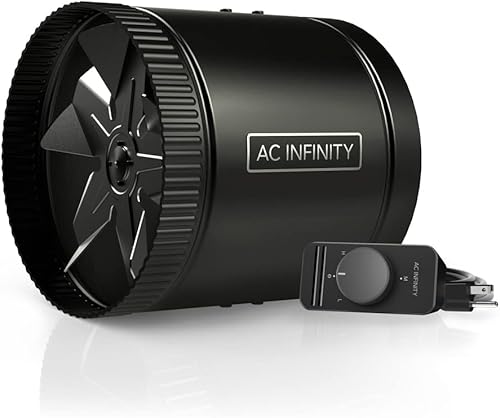
- 8-inch inline booster fan
- 428 CFM airflow
- 43 dBA noise
- Variable speed controller
- Dual ball bearings
An 8-inch booster for larger duct runs, moving 428 CFM to help existing HVAC airflow reach far rooms.
Pros
- High 428 CFM for boost use
- 8-inch duct fit
- Variable speed control
Cons
- Louder at 43 dBA
- Not for restricted airflow use
The RAXIAL S8 suits a large duct that needs a boost. This 8-inch booster moves 428 CFM to help HVAC airflow reach attics, workshops and far rooms.
A variable speed controller lets you balance airflow against noise. At full speed it reaches 43 dBA, so plan for that sound level in a quiet room.
The unibody die-cast build and steel blades help reduce vibration and keep airflow smooth. Dual-ball bearings support steady operation in ducting.
AC Infinity says it can serve as an intake fan in grow rooms to bring in fresh air. That works when your exhaust fan creates the main pull.
The body measures 7.28 x 7.95 x 7.95 inches and installs inline in an 8-inch duct. Its larger size matches larger duct runs where a 6-inch booster would be undersized.
Trade-off: like the S6, it is not for restricted airflow use, and it is louder than the smaller booster. For small ducts, compare our best 3-inch inline duct fan roundup to keep sizes straight.
AC Infinity AIRPLATE T8: Best for cabinets

- Dual-fan cabinet system
- 104 CFM total airflow
- 19 dBA total noise
- Thermostat control
- Aluminum frames
A quiet dual-fan plate for cabinets, with a temperature display and thermostat programming in each unit.
Pros
- Very quiet at 19 dBA
- Temperature display
- Cabinet form factor
Cons
- Low airflow for tents
- Cabinet use only
The AIRPLATE T8 suits a cabinet that needs quiet cooling. Two fan units move 104 CFM at 19 dBA in total, which is the quietest setup in this list.
Each unit measures 6.3 x 6.3 x 1.3 inches and mounts in a cabinet or on a shelf. An on-board processor shows cabinet temperature on a digital readout.
Thermostat control, fan speed control and a SMART energy saving mode are built in. The controller uses a 6-foot probe to sense temperature where it matters.
CNC machined aluminum frames give the units a brushed black finish. Dual-ball bearings are rated for long service in vertical or horizontal mounting.
The system runs at 6 watts and uses a 2-pin power connector. That low draw suits cabinets that run for long hours in a living space.
Trade-off: 104 CFM is far too little for a grow tent. Use this for AV cabinets and home theater gear, and pick a duct fan for plant spaces.
Which AC Infinity Cloudline fan size fits your tent?
Pick the duct size before you pick the model. The fan must mate with your tent flange and ducting, or you will add adapters and leaks.
Tent size, light heat and duct length all push the fan choice in the same direction. A bigger tent with stronger lights and a longer duct run needs a larger duct opening and more CFM headroom.
A smaller fan run at full speed all day will be louder and less efficient than a larger fan run at a mid speed. That is why sizing up one duct size often improves comfort.
4-inch fans for small tents
The CLOUDLINE S4 is the 4-inch pick here, with 205 CFM for compact tents. It suits short duct runs and seedlings or a few plants under modest lights.
Our Best Inline Fan For Grow Tent guide helps you match fan size to tent size. Start there if your tent is under about 4 feet wide.
A 4-inch duct is easier to route through a closet or small room. That ease matters when the exhaust has to turn a corner or pass through a wall.
6-inch fans for mid-size tents
The CLOUDLINE A6 is the 6-inch pick, with 352 CFM for larger tents. It suits longer duct runs, filters and warmer rooms where a 4-inch fan would run at full speed all day.
A 6-inch booster such as the RAXIAL S6 can pair with this size for intake. That pairing keeps the duct sizes consistent from intake to exhaust.
8-inch and booster fans for duct runs
The RAXIAL S8 is an 8-inch booster, not a primary exhaust fan. Use it to push existing air farther, or as intake where your main fan pulls air out.
An 8-inch duct suits larger rooms and longer HVAC runs. It does not make the booster a better tent exhaust fan than a Cloudline model.
How do speed controls differ on these fans?
The Cloudline S4 and A6 use a wired 10-speed controller, so you get fixed steps you can set by hand. Both also work with smart controllers from the same family for climate triggers, timers and automation.
The RAXIAL boosters use a variable speed controller for duct boosting. Turn the knob to trade airflow against noise for the run you are helping.
The CLOUDRAY S6 has 10 speeds and 10 wind modes for canopy movement. That range helps you find gentle air for seedlings and stronger movement later.
Thermostat controllers on the AIRCOM T10 and AIRPLATE T8 raise fan speed as a cabinet warms. The AIRTAP T4 uses temperature triggers tied to HVAC activity.
Is a Cloudline fan better than a booster fan?
A Cloudline fan is better for exhaust because it is built to pull air out of a tent. A booster is better when air already moves and needs help reaching the end of a duct.
Use a Cloudline fan as the main exhaust, a booster as intake or a duct helper, and a clip fan for canopy air. That three-part setup covers fresh air in, stale air out and movement across leaves.
A booster can also help when a long duct run loses pressure. It adds push inside the duct, but it does not create the negative pressure that exhaust needs.
Restricted airflow is the key limit for the RAXIAL models. If a filter or tight bend chokes the duct, a booster is the wrong tool for that spot.
For intake, a booster can work well because the exhaust fan is already pulling. For exhaust, the Cloudline mixed flow design and EC motor are built to handle resistance from filters and bends.
What about lights and other climate gear?
Fans work best when lights and climate gear are sized as a set. Heat from lights is the main reason a tent fan runs harder through the day.
Our Best Grow Lights For Small Spaces guide helps you match light output to tent size. A smaller light load can mean a smaller, quieter fan.
Plan intake, exhaust and circulation together. A strong exhaust fan with no intake path will still struggle to pull air through the tent.
Carbon filters add resistance, so a fan that handles a short open duct may need a higher speed once a filter is installed. Plants also release moisture as they grow, so a tent that felt fine in week one may need more exhaust later.
Timers and controllers help you match fan speed to the light cycle. The fan is one part of holding the heat and humidity balance, alongside lights and intake air.
How should you set up and care for these fans?
Mount the inline fan where you can reach the controller and power cord. Leave room around the body so ducting connects straight and mounting straps stay tight.
Pad each duct connection so air leaks do not reduce airflow. Long, bent runs add resistance, so keep the path as short and straight as you can.
Clean fan blades and guards every few months with power off and unplugged. Dust on blades cuts airflow and makes the fan work harder.
Check straps and clamps after the first week of use. Ducting can settle as it warms, and a loose joint can let warm air spill back into the room.
Mounting and duct routing details
Horizontal mounting suits most tent tops where ducting runs straight out. Vertical mounting suits tight corners where ducting turns down through a floor or wall.
Keep the controller away from direct spray and excess humidity. A wired controller needs a clear path to the fan without pulling on the cable.
Support flexible ducting so it does not sag into tight bends. Sag adds resistance and can make a mid-size fan feel like a small one.
Seal joints with clamps first, then check for leaks with the fan running. A leak at the tent flange wastes airflow that should pass through the filter and duct.
For clip fans, check the pole clamp weekly at first. Vibration and oscillation can loosen a clamp over time, especially on smooth poles.
For cabinet and rack fans, keep vents clear of cables and paper. A fan that cannot exhaust to open air will run hotter and louder.
The verdict on the best AC Infinity Cloudline fan
The best AC Infinity Cloudline fan for most small grow spaces is the CLOUDLINE S4, because 205 CFM at 28 dBA fits compact tents with quiet, simple control.
Pick the CLOUDLINE A6 if your tent is mid-size or your duct run is long. Its 352 CFM gives you headroom that a 4-inch fan cannot match.
Add a CLOUDRAY S6 for canopy movement, and use a RAXIAL booster only for intake or duct help. That mix gives you exhaust, intake and circulation in one setup.
For room registers, the AIRTAP T4 fits a 4 x 10 inch opening and responds to HVAC changes. For AV racks and cabinets, the AIRCOM T10, Rack Roof Fan Kit and AIRPLATE T8 each fit a specific form factor.
Confirm your duct size first, then your tent size and noise limit. That order prevents the common mistake of buying airflow that your ducting cannot use.
Next, confirm your duct size and tent dimensions, then pick the Cloudline fan that matches both.
Our top 3 picks at a glance
-
1
-
2
-
3
Frequently asked questions
What size Cloudline fan should I buy?
Buy by duct size and tent volume first. A 4-inch fan suits small tents and short duct runs, while a 6-inch fan suits larger tents and longer runs.
Match the fan to your existing ducting before you compare extra controls.
Is a Cloudline fan the same as a booster fan?
No. A Cloudline fan is built to exhaust air from a tent or room, while a booster helps existing duct airflow move farther.
Use a booster for intake or long HVAC runs, and a full inline fan for primary exhaust.
What does PWM control do?
PWM control varies motor speed smoothly to match airflow needs. It helps keep noise low at lower speeds and raises output when heat builds.
A 10-speed wired controller gives you fixed steps for manual tuning.
Do I need an oscillating fan with an inline fan?
Yes, in most tents. The inline fan changes the air in the space, and the clip fan moves air across leaves and stems.
That mix helps avoid still pockets where heat and humidity can build.