9 Best Seed Starting Trays (November 2026)
The best seed starting trays include the Gardzen 5-Set Seed Starter Tray Kits for most indoor gardeners, the Gardzen Seed Starter Tray for high-density sowing, and the MIXC 10 Pack Seed Starter Tray for many small batches.
On this page (9 sections)
- Our top seed starting trays, compared by cell size and setup
- How to use the best seed starting trays for indoor sowing
- How we compared these seed starting trays
- What cell count should you buy in seed starting trays?
- Do you need a humidity dome or a flat without one?
- Which tray size fits your shelf, rack or windowsill?
- Should you buy a tray with a grow light built in?
- How do drainage, inserts and watering change your choice?
- Verdict: which seed starting tray should you buy?
The best seed starting trays for most indoor gardeners are complete kits with cells, a base tray and a vented dome. That setup holds moisture during germination, catches extra water, and lets you adjust air as seedlings grow.
A tray is more than a plastic container. Cell size controls root space, drainage controls wet soil, and a dome controls humidity.
Our picks cover small windowsill kits, bulk 40-cell trays, deep 1020 flats and a tray with a built-in grow light.
You can also start with a propagation station if you want one place for trays, tools and supplies. That helps you keep sowing, watering and labeling in the same spot.
Our picks at a glance
-
1
 Best for most indoor gardeners
Gardzen 5-Set Seed Starter Tray Kits
9.7/10 our score
See it on Amazon -
2

-
3

- 4
 Best for compact shelvesCheck it
- 5
 Check it
Bootstrap Farmer 5-Pack Black 1020 Trays
Best for bottom watering flats - 6
 Check it
Mr. Pen- Seed Starter Tray Kits
Best for small 12-cell kits - 7
 Check it
BlumWay Seed Starter Tray with Grow Light
Best for low-light rooms - 8
 Check it
Mr. Pen- Seed Starter Tray Kits
Best for bulk 40-cell kits - 9
 Check it
RooTrimmer 1020 Flat Seed Starter Trays
Best for microgreens and pots
Our top seed starting trays, compared by cell size and setup
The Gardzen 5-Set kit leads our list for balanced capacity and a complete setup. The Gardzen 70-cell tray wins for high-density sowing, while the Bootstrap Farmer flat wins when you want bottom watering without drainage holes.
Gardzen 5-Set Seed Starter Tray Kits: Best for most indoor gardeners
- 5 sets, 200 cells total
- 40 cells per tray
- Vented humidity domes
- Base trays with drainage holes
A complete kit with tray, dome and base for each set. The vented domes help you manage humidity as seedlings emerge.
Pros
- 200 cells across 5 sets
- Adjustable vents on domes
- Drainage holes in cell trays
Cons
- Cells are smaller than 70-cell trays
- Dome height limits tall seedlings
The Gardzen 5-Set Seed Starter Tray Kits suit gardeners who want a ready to use setup for vegetables, flowers and herbs. You get 5 sets with 200 cells total, and each tray holds 40 cells.
Each kit includes a tray, base and humidity dome. The dome has two vents you can slide open to add air and reduce overheating.
The clear dome also lets you check growth without lifting it.
The cell tray has drain holes at the bottom. Extra water drains into the base tray, which helps keep tables dry and reduces soggy soil.
The trays measure 9 x 14.5 x 1.85 inches. That footprint fits many shelves, but check your shelf depth before you stack several sets side by side.
A wall-mounted propagation station can keep supplies off the shelf.
Gardzen lists 1.4 inch cell space to help prevent root crowding. Cells that size suit most home sowings and give young roots room before transplanting.
The trade-off is cell size. If you sow peppers or cole crops in large numbers, a 70-cell tray gives you more starts per tray.
If you want deep flats for pots, a 1020 flat is a better fit.
Gardzen Seed Starter Tray: Best for high-density sowing
- 5 pack, 350 cells total
- 70 cells per tray
- 1.5 in square cells
- Transparent vented domes and bases
Small 1.5 inch cells give you many starts per tray. This suits peppers, cabbage, kale, broccoli and early cole crops.
Pros
- 350 cells for large sowings
- Drainage holes in each cell
- Domes snap over tray and base
Cons
- Small cells need earlier transplanting
- Large footprint per tray
The Gardzen Seed Starter Tray suits gardeners who sow in large numbers. This 5 pack gives you 350 cells total, with 70 cells in each tray.
Each cell measures 1.5 inches square. That size works for early peppers, cabbage, kale, broccoli and Brussels sprouts, among other crops Gardzen names.
For edible microgreens, compare microgreen seed varieties.
Each kit includes a seed tray, a base tray and a transparent dome. The dome snaps over the two bottom trays to create a humid cover during germination.
Drain holes sit at the bottom of the seed tray. Extra water drains into the base tray so you can see how much water the soil is holding.
The trays measure about 17.3 x 13 x 2.4 inches. That is a wide footprint, so measure your shelf or table before you buy a full set.
Small cells are the main trade-off. They give you many starts, but roots fill the space fast.
Plan to transplant vine plants and other fast growers earlier than you would from larger cells.
MIXC 10 Pack Seed Starter Tray: Best for many small batches
- 10 pack, 120 cells total
- 12 cells per tray
- 10 humidity domes
- 10 watertight base trays and labels
Ten small kits let you stagger sowings by variety or date. Each kit has a dome, base tray and plant label.
Pros
- 10 separate starter kits
- Adjustable vents on domes
- Drainage holes reduce root rot risk
Cons
- 12 cells per tray is a small batch
- Smaller trays take more shelf space
The MIXC 10 Pack Seed Starter Tray suits gardeners who like to sow small batches on different dates. You get 10 trays and 120 cells total, with 12 cells per tray.
Each kit includes 10 trays, 10 watertight base trays, 10 humidity domes and 10 plant labels. That makes it easy to label each variety and date.
The domes have adjustable vents. You can close them to hold humidity for germination, then open them as seedlings emerge.
Drain holes at the bottom of each cell help water leave the soil. That lowers the risk of root rot compared with a tray that traps water.
The trays are made of durable plastic and can be reused for multiple seasons. They are also lightweight and easy to carry from room to room.
The trade-off is batch size. Twelve cells per tray is small if you want to sow a full row of one crop.
It is a good fit when you grow several herbs, flowers or vegetables in small amounts.
MIXC 5 Pack Seed Starter Tray: Best for compact shelves
- 5 pack, 200 cells total
- Cells 1.5 x 1.5 x 2 in
- Dome height 2.75 in
- 5 trays, 5 bottom trays, 5 domes, tools and labels
A 200-cell mini propagator kit with adjustable vents. Bottom trays stack to save space before germination.
Pros
- Transparent trays for easy checks
- Stackable bottom trays
- Includes garden tools and labels
Cons
- 2.75 in dome height is short
- Cells suit small seeds best
The MIXC 5 Pack Seed Starter Tray suits compact shelves and small indoor gardens. This kit gives you 200 cells across 5 trays, with a mini propagator setup in each set.
Each set includes a seed tray, a bottom tray and a humidity dome. The kit also includes 2 garden tools and 10 plant labels.
Cells measure 1.5 x 1.5 x 2 inches. MIXC says that size suits small seeds, and the transparent plastic lets you observe plants without opening the dome.
The domes have adjustable vents for temperature and humidity control. Open the vents as seedlings grow to give them fresh air.
The product measures 14.6 x 9.84 x 5.1 inches, with a dome height of 2.75 inches. That low dome saves space, but tall seedlings will reach the top fast.
Bottom trays can be stacked to save space before seeds germinate. That helps when you start seeds indoors in a small area.
The trade-off is height and cell depth. If you grow tall seedlings or want deeper roots, look at a taller dome or a deep flat instead.
Bootstrap Farmer 5-Pack Black 1020 Trays: Best for bottom watering flats
- 5 black 1020 trays
- 2.525 in deep
- No drain holes
- 21 x 11 in outer size
Solid flats with no drain holes for bottom watering. The 2.5 inch depth holds 3.3 inch pots or a 1020 cell tray.
Pros
- Deep 2.5 in flats
- Solid bottom holds water
- Fits commercial greenhouse racking
Cons
- No drain holes by design
- No domes or cells included
The Bootstrap Farmer 5-Pack Black 1020 Trays suit gardeners who water from the bottom. These are solid flats with no drain holes, measuring 21 x 11 x 2.525 inches.
The 2.5 inch depth gives you more room than a shallow flat. Bootstrap Farmer says the flats can hold 18 standard 3.3 inch pots or nest a 1020 cell tray for bottom watering.
The black opaque plastic blocks light during germination. That can help when you want a dark cover over soil or seedlings.
The material is food safe PP 5 plastic. Bootstrap Farmer says it supports hydroponic and soilless growing systems.
The outer size fits commercial greenhouse racking. That standard 1020 size also makes it easier to find inserts, domes and carriers that fit.
For trays set up for microgreens, see microgreen growing trays.
The trade-off is clear. These flats have no drainage holes, so you must manage water yourself.
If you want top drainage, order a tray with holes or use a cell tray inside the flat.
Mr. Pen- Seed Starter Tray Kits: Best for small 12-cell kits
- 10 set, 120 cells total
- 12 cells per tray
- Transparent domes with adjustable vents
- Shovel and scoop included
Ten compact 12-cell kits for a windowsill or shelf. Drain holes help prevent overwatering and root rot.
Pros
- Compact kit size
- Drain hole in each cell
- Tools included for planting
Cons
- Small cell count per kit
- Kit footprint needs care on shelves
The Mr. Pen Seed Starter Tray Kits suit small indoor projects and windowsill sowings.
This pack gives you 10 sets and 120 cells total, with 12 cells per kit.
Each tray measures 6.6 x 4.6 inches. That compact size fits narrow shelves and small tables where a full 1020 flat will not fit.
The trays are made of durable plastic with a transparent dome lid. The dome helps retain moisture, and adjustable vents add air when seedlings need it.
Each cell has a drain hole at the base. That helps prevent overwatering and keeps roots from sitting in standing water.
The design helps release seedlings with minimal root disturbance. That matters when you separate young plants for transplanting.
The kit includes a shovel and scoop for planting and transplanting. You get the basic tools to sow seeds without buying them separately.
The trade-off is capacity. Twelve cells per tray is best for herbs, a few flowers or a small vegetable batch.
For a full garden sowing, a 40-cell kit will save you time.
BlumWay Seed Starter Tray with Grow Light: Best for low-light rooms
- 2 pack, 80 cells total
- Full-spectrum grow light strips on dome
- Timer and brightness settings
- 9 cm tall domes
A seed starter tray with a grow light mounted on the dome. Timers and brightness modes help seedlings grow in low light.
Pros
- Built-in grow light strips
- Adjustable vents and timer
- Deeper 1.96 in cell trays
Cons
- Only 80 cells across 2 trays
- Light adds setup complexity
The BlumWay Seed Starter Tray with Grow Light suits gardeners with low-light rooms. This 2 pack gives you 80 cells total, with a full-spectrum grow light mounted on each dome.
The light has 4 full-spectrum strips and 80 lamp beads across the two trays. BlumWay lists 3 lighting modes, 3 timer settings and 5 brightness modes.
The domes stand 9 cm tall. That extra height gives seedlings more room before they touch the cover.
Cell trays measure 1.96 inches deep, with 0.31 inch drainage holes. Deeper cells help build stronger roots, and drainage helps prevent overwatering and root rot.
The trays are made of thickened ABS plastic. BlumWay says the plastic is anti-UV, corrosion-resistant and easy to carry and clean.
You can power the light by USB or with the included plug-in adapter. That gives you options for a shelf, desk or tabletop setup.
The trade-off is cell count and complexity. Eighty cells is fewer than bulk kits, and a light adds timers and settings to manage.
It is a strong pick when window light is weak.
Mr. Pen- Seed Starter Tray Kits: Best for bulk 40-cell kits
- 10 pack, 400 cells total
- 40 cells per tray
- 10 bases and 10 vented domes
- Dibber, widger, shovel and scoop
Ten 40-cell kits for large sowings, classrooms or greenhouse work. Clear domes help you monitor growth.
Pros
- 400 cells for bulk sowing
- Full tool set included
- Clear domes for monitoring
Cons
- Large total storage volume
- 40-cell trays are fuller to manage
The Mr. Pen Seed Starter Tray Kits suit large sowings, classrooms and greenhouse projects.
This 10 pack gives you 400 cells total, with 40 cells per tray.
Each kit includes 10 durable base trays, 10 seed trays and 10 transparent domes. The domes create warmth and humidity to help seedlings sprout.
Clear domes make it easy to monitor growth. You can check progress without lifting the cover and losing humidity.
The kit also includes a dibber and a widger, plus a shovel and scoop. Those tools help you sow seeds at a steady depth and transplant seedlings with less damage.
The trays measure 14.5 x 9 x 4.3 inches. That size fits many shelves, but ten sets will take real space when they are all in use.
The trade-off is storage and handling. Four hundred cells is a lot to water, label and move at once.
It is best when you truly need that many starts in one sowing.
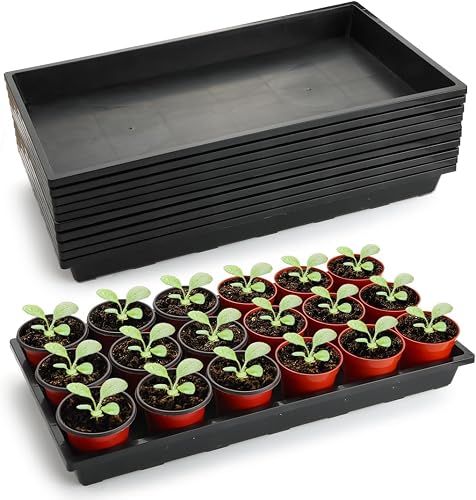
RooTrimmer 1020 Flat Seed Starter Trays: Best for microgreens and pots
- 10 pack 1020 flats
- 21.3 x 10.9 x 2.1 in
- No drainage holes
- BPA-free plastic
Plain 1020 flats with no drain holes. They hold soil for microgreens or carry nursery pots indoors and out.
Pros
- 10 flats for carrying pots
- No holes for microgreens soil
- Moves without leaking
Cons
- No cells, domes or drainage
- Shallow 2.1 in depth
The RooTrimmer 1020 Flat Seed Starter Trays suit microgreens, nursery pots and carrying seedlings. This pack gives you 10 black flats with no drainage holes.
Each flat measures 21.3 x 10.9 x 2.1 inches. That shallow depth works well for soil used for microgreens and for holding pots during transport.
The plastic is BPA-free. RooTrimmer says the trays can hold a large amount of soil for starting seeds, growing microgreens and holding nursery pots.
The solid design helps you move planters without leakage. That saves watering time and keeps soil from dirtying the surface below.
You can use the flats for wheatgrass, cat grass, bonsai trays and general indoor gardening. The 1020 size also fits many greenhouse carriers and racks.
The trade-off is depth and drainage. At 2.1 inches deep, these flats are shallower than the Bootstrap Farmer flats.
They also have no holes, so they are not right for top watering.
How to use the best seed starting trays for indoor sowing
The best seed starting trays work best when you fill them with moist mix, sow at the right depth, cover them, and adjust water and air each day. A simple routine beats guesswork.
Fill each cell with moist Best Seed Starting Mix, then press it down lightly so there are no large air pockets. Sow one or two seeds per cell, cover them to the depth listed for that seed, and water gently.
Set the cell tray in its base tray before you water. That way extra water drains down and you can see if the soil is drying out.
Place the dome over the tray until seeds sprout. Open the vents a little each day, then open them more as seedlings grow.
Remove the dome when leaves start to touch it.
Use our guide to how to use a seed starting tray for step-by-step sowing, watering and transplant timing. It covers the same routine you will use with any kit in this roundup.
How we compared these seed starting trays
We compared cell count, cell size, tray footprint, dome height, drainage, included tools and price tier. We also checked how each tray fits a shelf, a windowsill or a greenhouse rack.
We weighed specs and features against what home gardeners actually need. A complete kit scored higher than a plain flat because it covers moisture, drainage and labeling in one purchase.
We looked for honest trade-offs. Small cells give more starts but need earlier transplanting.
Solid flats water well from below but need careful water management. Built-in lights help low-light rooms but add settings to learn.
Our score weighs specs, features and buyer feedback against what you're shopping for. That is why the Gardzen 5-Set kit leads, even though other trays win for bulk sowing or bottom watering.
What cell count should you buy in seed starting trays?
The right cell count depends on how many plants you want from one sowing. More cells mean more starts, but each cell is usually smaller.
12-cell trays for herbs and small batches
Choose 12-cell kits like the MIXC 10 pack or the Mr. Pen 10 set when you sow a few herbs or flowers.
Small trays are easy to move and easy to label.
40-cell trays for home gardens
Choose 40-cell kits like the Gardzen 5-Set or the Mr. Pen 400-cell pack for a full home garden.
You get room for several varieties without filling the whole table.
70-cell trays for high-density sowing
Choose 70-cell trays like the Gardzen 350-cell pack when you want many small starts. Plan to transplant early, because 1.5 inch cells fill up fast.
If you want even more control over cell size, our best bulk seed starting trays guide compares bulk options for large sowings. Our best deep seed starting trays guide covers deeper cells for stronger roots.
Do you need a humidity dome or a flat without one?
A humidity dome helps seeds sprout by holding moisture around the soil. It is most useful in dry indoor air or in winter.
Vented domes for germination
Choose a kit with a vented dome when you start seeds indoors. Vents let you add air in small steps instead of lifting the whole cover.
Our best seed starting trays with dome guide covers dome height, vent design and when to remove the cover. Taller domes give seedlings more room, but they also hold more humid air.
Solid flats for bottom watering
Choose a solid flat when you want to water from below or carry pots. The Bootstrap Farmer and RooTrimmer flats have no drain holes for that reason.
A best humidity dome for 1020 tray can turn a plain 1020 flat into a mini greenhouse. That combo suits microgreens, pots and cell trays that need extra humidity.
Which tray size fits your shelf, rack or windowsill?
Tray size matters more than most buyers expect. A tray that is too wide will not fit your shelf, and a tray that is too tall will not fit under a light.
Measure your shelf depth, then compare it with the tray footprint. Full 1020 flats measure about 21 by 11 inches, so they need a full rack or a wide table.
Smaller kits such as 14.5 by 9 inches fit more shelves. The Gardzen 5-Set, MIXC 5 pack and both Mr.
Pen kits use that general size.
Our best 1020 seed starting trays guide explains the standard size and how to use it with inserts and carriers. If you want trays you can reuse for years, our best reusable seed starting trays guide covers durable options.
Should you buy a tray with a grow light built in?
A grow light helps when your window light is weak or short in winter. Seedlings grown in low light often grow tall and pale.
When a built-in light helps
Choose a tray like the BlumWay kit when you have no sunny windowsill. The light sits on the dome, close to the seedlings, and timers reduce daily work.
When a separate light is better
Choose a separate light when you already own a shelf light or want to cover many trays at once. Our Best Grow Lights For Seed Starting guide covers light size, timers and placement.
A built-in light is simpler for one or two trays. A separate light is better when you scale up to many trays on a rack.
How do drainage, inserts and watering change your choice?
Drainage holes, solid bottoms and inserts each solve a different watering problem. Match the tray to how you like to water.
Drainage holes for top watering
Choose cell trays with drainage holes when you water from above. Extra water leaves the soil and collects in the base tray.
Solid bottoms for bottom watering
Choose solid flats when you water from below. The soil stays in the tray, and roots can take up water as needed.
Inserts for flexible cell sizes
Inserts let you change cell size without buying a whole new kit. Our best seed tray inserts guide covers sizes and fit.
If you prefer soil that wicks water on its own, our best self watering seed starting trays guide covers that style. If you want soft, flexible trays, our best silicone seed starting trays guide covers that option too.
Verdict: which seed starting tray should you buy?
Buy the Gardzen 5-Set Seed Starter Tray Kits if you want one complete kit for most home sowings. It gives you 200 cells, vented domes and base trays with drainage.
Buy the Gardzen 70-cell tray if you sow in large numbers and can transplant early. Buy the Bootstrap Farmer flats if you want bottom watering and a deep 1020 flat.
Buy the BlumWay tray with grow light if your room has weak light. Buy the **Mr.
Pen 400-cell kits** if you need bulk capacity for a classroom or greenhouse.
For your next sowing, pair your tray with a good mix and light, then follow our how to use a seed starting tray routine for steady, healthy seedlings.
Our top 3 picks at a glance
-
1
Best for most indoor gardeners
Gardzen 5-Set Seed Starter Tray Kits
9.7/10 our score
See it on Amazon -
2
-
3
Frequently asked questions
How many cells do I need in a seed starting tray?
Start with 40 cells per tray if you sow vegetables or flowers for a home garden. That gives room to grow several varieties without crowding roots.
Choose 70 cells only when you want many small starts and plan to transplant early.
Do I need a humidity dome for seed starting?
A dome helps keep humidity steady until seeds sprout. Open the vents once seedlings emerge so air can move and stems grow sturdy.
Remove or prop the dome when leaves touch the top to avoid damp, weak growth.
Should seed trays have drainage holes?
Cell trays should have drainage holes so extra water can leave the soil. Solid flats with no holes are better for bottom watering or for holding soil for microgreens.
Match the tray type to how you plan to water.
Can I reuse plastic seed starting trays?
Yes, many plastic trays can be reused for multiple seasons. Wash off old soil, let the trays dry, and check for cracks before filling them again.
Strong, intact trays save money and reduce waste compared with replacing them each season.
What size tray fits a standard shelf or rack?
Measure your shelf depth before you buy, then compare it with the tray footprint. Full 1020 flats measure about 21 by 11 inches.
Smaller kits such as 14.5 by 9 inches fit more shelves and windowsills with less planning.