9 Best Raised Self-Watering Planters (November 2026)
The best raised self-watering planters include the Keter Urban Bloomer 12.7 Gallon Raised Garden for compact herb gardens, the Rolling Citrus Tree Planter Gen for patio fruit trees, and the VECELO 5 Tier Vertical Garden Planter for vertical growing.
On this page (6 sections)
- Which raised self-watering planters fit different spaces?
- How do you choose a raised self-watering planter?
- Do raised self-watering planters prevent overwatering?
- Which plants work best in a raised reservoir planter?
- How do raised beds compare with regular self-watering pots?
- Which raised self-watering planter should you choose?
The Keter Urban Bloomer is the best raised self-watering planter for most small patios, combining a raised bed with a water gauge and controllable drainage. Choose a broad bed for mixed vegetables, a trellised model for climbing crops or a wheeled round pot for a patio tree.
Raised planters bring the growing area closer to you, while reservoir watering can reduce how often you need to water by hand. The best fit depends on what you want to grow, how much room you have and whether you need to move the container.
For a broader comparison of container styles, see our Best Self Watering Planter guide. If you're deciding how a reservoir system works, our guide to what makes a self-watering planter the best choice explains the key parts.
Our picks at a glance
-
1
 Best for compact herb gardens
Keter Urban Bloomer 12.7 Gallon Raised Garden
9.7/10 our score
See it on Amazon -
2

-
3

- 4
 Check it
LINEX Raised Garden Bed Planter Box
Best for climbing crops - 5
 Check it
Keter Splendor 31.7 Gallon Raised Garden Bed
Best for broad vegetable beds - 6
 Check it
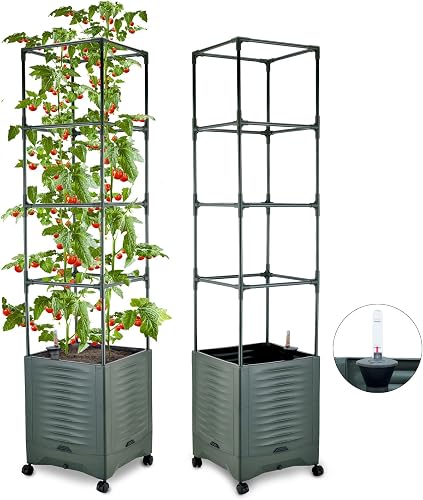
TeCreatio Tomato Planter Pot Tomato Box Raised
Best for supported tomatoes - 7
 Check it
Vego garden EZCube Self Watering Planter Box
Best for a wide raised bed - 8
 Check it
VINGLI Square Raised Garden Bed
Best for flexible bed layouts - 9
 Check it
Giantex Raised Garden Beds Outdoor Set
Best for a pair of smaller beds
Which raised self-watering planters fit different spaces?
The best raised self-watering planters match the crop and footprint to your available space. The Urban Bloomer is a compact choice for herbs, while the Splendor and EZCube offer longer beds for larger planting plans.
Keter Urban Bloomer 12.7 Gallon Raised Garden: Best for compact herb gardens
- 12.7-gallon soil capacity
- Built-in water gauge
- Reservoir and drainage plug
- 32.3 x 14.7 x 30.7 in
A raised, narrow bed with a water gauge and drainage plug suits herbs on a patio or balcony. Its 12.7-gallon soil capacity gives you room for a small mixed planting.
Pros
- Water gauge shows when plants need more moisture
- Drainage can be opened or closed
- Raised shape fits many patios
Cons
- Narrow bed limits large or sprawling plantings
- Requires assembly
The Keter Urban Bloomer suits herbs and small plantings on a balcony or patio. Its 12.7-gallon soil capacity sits in a raised frame measuring 32.3 x 14.7 x 30.7 inches.
A built-in water gauge indicates when plants need more moisture. The reservoir is designed to prevent root decay and overwatering, and its drainage plug can be opened or closed for more control over watering.
This is a useful layout if you want a planter that leaves a smaller footprint than a long garden bed. The narrow shape gives less room for sprawling vegetables, so check the mature size and spacing needs of your plants first.
Choose it for accessible herb growing with a gauge and drainage control. Read our Best Raised Planter Box picks if bed size and shape matter more than reservoir features.
Rolling Citrus Tree Planter Gen: Best for patio fruit trees
- 30-gallon capacity
- 24 x 24 x 17 in
- Wicking reservoir and water gauge
- Locking caster wheels
This round, 30-gallon planter is designed for citrus and other patio-grown trees. A watering tube and gauge support reservoir refills, while locking wheels help move the pot.
Pros
- Large capacity for a tree container
- Water gauge and refill tube
- Locking caster wheels
Cons
- Round footprint needs more floor space than a narrow bed
- Confirm seasonal light and cold protection needs for your tree
The Rolling Citrus Tree Planter suits a patio tree that needs a large container and occasional repositioning. It has a 30-gallon capacity and measures 24 x 24 x 17 inches.
Its reservoir and wicking system move moisture toward roots, while a refill tube lets you add water without disturbing the plant. A built-in gauge helps you monitor the water level, and locking caster wheels make the planter easier to move around a deck or patio.
The round shape takes more floor space than a narrow rectangular bed, so measure the intended spot with room to roll the planter. The listed model name says Gen 3, while its set name says Gen 2, so confirm the version before ordering.
Choose it for a fruit tree or other large patio plant that benefits from mobility. Its size and round footprint make it less suited to a very tight balcony.
VECELO 5 Tier Vertical Garden Planter: Best for vertical growing
- 5 stackable tiers
- 13.19 x 13.19 x 30.31 in
- Wheels for moving
- Indoor or outdoor use
Five stacked pots use vertical space for herbs, flowers, vegetables or strawberries. Wheels make it easier to move the tower when its sun exposure or position needs to change.
Pros
- Small footprint for a tiered garden
- Stackable pots
- Wheels support moving the tower
Cons
- Tiered layout offers less room per planting than a broad bed
- Check how water drains between levels
The VECELO tower suits a small space where you want several planting levels instead of a wide bed. It stacks 5 tiers within a footprint of about 13.19 x 13.19 inches and stands 30.31 inches tall.
The planter is designed for strawberries, herbs, flowers and vegetables. Its drainage feature channels excess water away, and wheels make it easier to move the tower toward better sun or out of the way.
A vertical stack gives each tier less horizontal room than a broad raised bed. Check the plant's mature size and watering needs at each level, since upper and lower pots can dry at different rates.
Choose this layout when floor space is limited and your plants suit smaller pockets. For a crop-by-crop guide, read what plants thrive in self-watering pots.
LINEX Raised Garden Bed Planter Box: Best for climbing crops
- 8.3-gallon planter box
- 54.5 in trellis
- Reservoir and 4 drainage holes
- 5 casters, 4 locking
A tall trellis gives climbing crops a support structure above the planter box. The reservoir, drainage holes and locking casters add watering and placement options.
Pros
- Trellis supports climbing plants
- Reservoir plus drainage holes
- Casters make the unit movable
Cons
- Narrow box limits planting width
- Tall trellis needs a clear spot
The LINEX planter is designed for climbing plants that need support above the soil. Its box has an 8.3-gallon capacity, with a 54.5-inch trellis and an overall listed height of 67.6 inches.
The reservoir is paired with four drainage holes, giving water a way to reach the roots while allowing excess to escape. Five casters, four with locks, make it possible to shift the unit for sun or shade.
This taller option has a narrower base than a typical rectangular bed. Check the growing plant's height, trellis needs and available clearance before choosing a spot.
Pick it for tomatoes, vines or flowers that benefit from a trellis. If you want more room for mixed plantings at a similar raised height, compare it with a broad box.
Keter Splendor 31.7 Gallon Raised Garden Bed: Best for broad vegetable beds
- 31.7-gallon capacity
- 44.8 x 19.4 x 29.8 in
- Water gauge and reservoir
- Adjustable drainage
This wide, raised bed offers more soil capacity for vegetables, herbs or flowers than compact planter boxes. Its gauge and controllable drainage help you manage reservoir watering.
Pros
- Broad planting area
- Water gauge indicates when to refill
- Drainage can be opened or closed
Cons
- Needs more floor space than a compact bed
- Check indoor placement and drainage plans
The Keter Splendor is a broad choice for a mixed vegetable, herb or flower bed. Its 31.7-gallon capacity and 44.8 x 19.4 x 29.8-inch footprint give plants more soil room than the compact models here.
A water gauge shows when plants need more moisture, and the drainage system can be opened or closed. The reservoir is designed to reduce overwatering and root decay, while the raised bed can be used indoors or outdoors.
For a larger indoor setup, see large self-watering planters.
The longer shape works well when you can place it along a patio edge or balcony wall. Make sure the spot can handle the filled planter's weight and has a plan for draining water when needed.
Choose it when you want more planting area than a narrow herb box can offer. It is less convenient to reposition than a planter with wheels.
TeCreatio Tomato Planter Pot Tomato Box Raised: Best for supported tomatoes
- 2-gallon reservoir
- Water inlet and indicator
- 56.5 in metal trellis
- 5 wheels, 4 with brakes
A tall metal trellis and water indicator make this a focused choice for tomatoes and other climbing plants. Its small footprint and wheels can help fit a supported plant into a patio layout.
Pros
- Trellis provides climbing support
- Water inlet and indicator
- Wheels include 4 brakes
Cons
- Focused on a single planter rather than a broad bed
- Reservoir capacity is 2 gallons
The TeCreatio tomato planter combines a tall metal trellis with a water reservoir and indicator. Its 2-gallon reservoir and 56.5-inch height are aimed at supported tomato growing in a compact floor area.
A water inlet directs refills into the reservoir, and the indicator helps you track its level. Five wheels, four with brakes, make it easier to adjust the planter's position as sunlight changes.
The design is focused on one planter and its trellis, so it doesn't offer the broad soil area of a raised bed. Use it for a climbing crop that can grow in the container's footprint, and check plant spacing before adding companions.
Choose it for tomatoes when a vertical support and movable base matter most. For a wider area to grow several plants, look at the rectangular raised beds instead.
Vego garden EZCube Self Watering Planter Box: Best for a wide raised bed
- 21 x 48 x 29 in
- Water gauge with float indicator
- Reservoir and drainage holes
- AirEase vent
The 48-inch width gives you a long raised planting area, while a float gauge marks refill and maximum levels. Venting and drainage holes address airflow and excess water.
Pros
- Long raised bed shape
- Visual refill and maximum markers
- Vent and drainage holes
Cons
- Capacity is not specified
- Confirm the space available for its wide footprint
The Vego Garden EZCube fits a long planting area where a visible water gauge is useful. It measures 21 x 48 x 29 inches, with a float indicator that marks maximum and refill levels.
Its reservoir supports self-watering, and the planter also has an AirEase vent and drainage holes. Those openings are designed to improve airflow and allow excess water to leave the bed.
Capacity is not specified here, so plan around the dimensions and the soil needs of your intended plants. Its wide footprint suits a patio wall or open deck better than a narrow walkway.
Choose it for a long raised bed with clear refill markers. If the crop needs a trellis, select a supported planter such as the LINEX or TeCreatio instead.
VINGLI Square Raised Garden Bed: Best for flexible bed layouts
- Flexible combinations
- Reinforced plastic
- Drainage holes
- 48.4 x 15 x 31.8 in
The pieces can be combined in different arrangements to suit a garden layout. Its self-watering design draws up water and uses drainage holes to let excess water escape.
Pros
- Flexible arrangement options
- Drainage holes for excess water
- Lightweight, weather-resistant plastic
Cons
- Capacity is not clearly stated
- Confirm the exact assembled footprint before setting it up
The VINGLI raised bed is for gardeners who want to arrange planter pieces to fit a particular space. Its design allows flexible combinations, and the reinforced plastic is described as lightweight and weather-resistant.
The self-watering design helps the bed absorb water, while drainage holes release excess. That combination can suit vegetables or flowers where you want a raised layout with adjustable placement.
The capacity and exact assembled footprint are not clear, so confirm both before you set aside a spot. The dimensions shown are 48.4 x 15 x 31.8 inches, but flexible configurations may change the overall shape.
Choose it when layout flexibility is a priority and you can confirm the assembled dimensions. For a fixed, clearly sized box with a reservoir gauge, consider the Keter options.
Giantex Raised Garden Beds Outdoor Set: Best for a pair of smaller beds
- Set of 2
- 7.7-gallon capacity each
- 1.1-gallon reservoir
- Detachable legs
The set gives you two raised containers with detachable legs, so you can arrange separate plantings or remove the legs as needed. Each bed has a reservoir and drainage hole.
Pros
- Two planters in the set
- Legs can be removed
- Reservoir plus drainage hole
Cons
- Each planter has less capacity than the larger beds
- Check the space needed for both units
The Giantex set gives you 2 raised beds with detachable legs, each with a 7.7-gallon capacity. The listed dimensions for each are 31.5 x 12 x 16 inches.
Each planter has a 1.1-gallon reservoir and a drainage hole. The legs lift the containers and can be removed when you want a lower setup, so the pair can work for separate herbs or small vegetables.
The two beds need more combined floor space than a single container, even if you place them side by side. Measure the space for both and consider how you'll reach each one for filling and draining.
Choose this set when you prefer separate smaller beds and want leg height to be adjustable. For one larger bed, the Keter Splendor offers more capacity in a single container.
How do you choose a raised self-watering planter?
Choose a raised self-watering planter by matching its soil area, height and water system to your plants and space. A reservoir helps manage watering, but it doesn't replace checking moisture, drainage and plant needs.
Start with the crop. Herbs and compact vegetables can fit a narrow bed, while climbing tomatoes need a trellis or another support, and patio trees need a much larger container.
Next, measure the location, including width, depth and height. Leave room to reach the reservoir, check the water gauge, harvest, and move a wheeled planter if it has casters.
Finally, check drainage. A reservoir is useful only when the system also lets you avoid waterlogged soil; follow the planter's fill guidance and drain excess water when needed.
Do raised self-watering planters prevent overwatering?
No, a raised self-watering planter doesn't guarantee that plants won't receive too much water. Reservoirs, gauges and drainage features help you manage watering, but weather, plant size and growing mix also affect how quickly a container uses moisture.
Use the gauge or refill marker as a guide rather than filling automatically on a fixed schedule. Check that drainage openings remain clear and follow the care needs of the plants you're growing.
Which plants work best in a raised reservoir planter?
Herbs, vegetables and flowers can suit raised reservoir planters when the container gives them enough soil room and light. A trellis helps climbing crops, while a roomy round planter gives a patio tree more growing space than a narrow box.
Avoid choosing by watering style alone. Compare mature plant size and root depth with the container dimensions, then decide whether the planter's shape supports your crop.
How do raised beds compare with regular self-watering pots?
Raised beds offer a larger planting area and bring soil closer to a standing or seated gardener, while pots usually fit one plant or a smaller group. A self-watering pot can be easier to place, but a bed may suit mixed plantings or vegetables.
If you want a broad raised container without a reservoir system, compare the Best Raised Planter Box options. For container styles beyond raised beds, start with the best self-watering planter guide.
Which raised self-watering planter should you choose?
Choose the Keter Urban Bloomer for a compact herb planter with a water gauge and adjustable drainage. Pick the Keter Splendor or Vego EZCube when you need a longer bed, and choose the Rolling Citrus Tree Planter for a large container with wheels.
For climbing tomatoes, select a trellised planter and check its footprint against your available space. Before planting, match the container to your crop and read our guide to plants suited to self-watering planters.
Our top 3 picks at a glance
-
1
Best for compact herb gardens
Keter Urban Bloomer 12.7 Gallon Raised Garden
9.7/10 our score
See it on Amazon -
2
-
3
Frequently asked questions
What is a raised self-watering planter?
A raised self-watering planter lifts the planting area and holds water in a reservoir below or beside the soil. A wick or similar path moves moisture toward the roots, while a gauge, refill tube or drainage opening can help you manage water.
Designs vary, so check how you fill and drain the specific planter.
Are raised self-watering planters good for vegetables?
They can suit vegetables when the bed has enough soil space, the crop gets suitable light and you can manage drainage. Wide beds fit mixed plantings, while trellised planters give climbing crops support.
For a self-watering container, match the crop to its soil depth and available growing area.
Can a self-watering planter be overwatered?
Yes. A reservoir does not remove the need to monitor moisture, and a planter without clear drainage can leave roots too wet.
Use the gauge or refill marks as a guide, follow the planter's drainage directions and check the soil before adding water.
See our guide to overwatering in a self-watering planter for more.
What plants do well in raised self-watering planters?
Herbs and many vegetables can grow well when the planter's depth, width and light suit the crop. Climbing plants benefit from a trellis, while a roomy tree planter is better suited to a patio tree than a small stacked pot.
Our guide to plants for self-watering planters covers how to match plants to container styles.