
What Size Grow Light Do I Need for My Grow Tent?
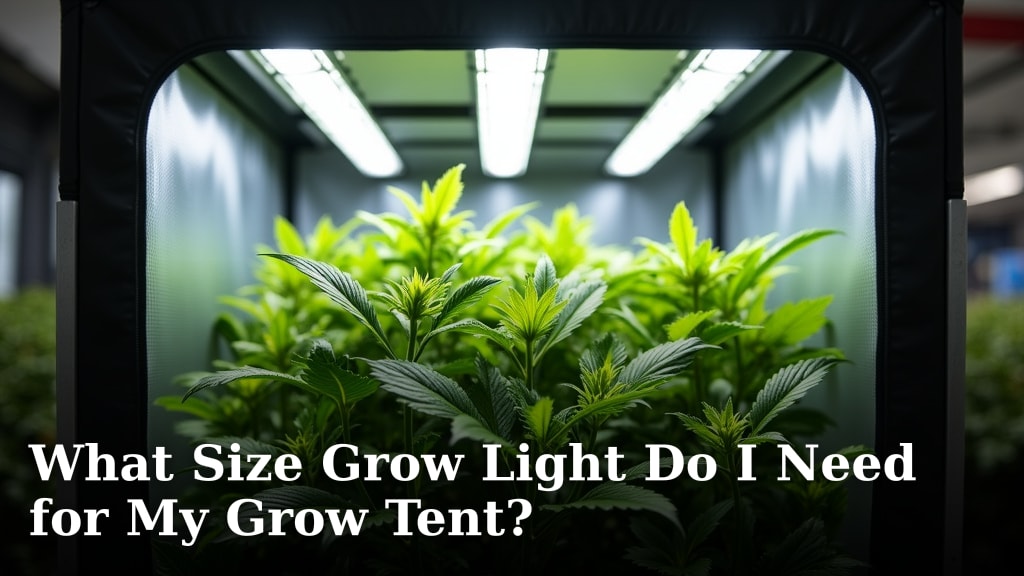
To determine what size grow light you need for your grow tent, aim for about 30-50 watts of actual LED power per square foot of grow space for flowering plants. For vegetative growth, 20-30 watts per square foot is often sufficient. This range helps ensure your plants get the right amount of light without waste.
Choosing the correct light prevents both under-lighting and over-lighting your plants. Too little light means slow growth and small yields, while too much can cause stress and burn your foliage. We found that matching your light to your tent size creates the best environment for healthy plants.
- Match watts per square foot to plant stage.
- Measure your grow tent’s footprint.
- Consider plant light needs (PPFD).
- Account for light type (LED vs. HPS).
Let’s walk through exactly how to calculate the perfect grow light size for your specific grow tent setup.
Matching Grow Light Size to Your Grow Tent
To successfully grow plants indoors, you need to match your light to your grow tent. Getting this right creates the perfect environment for your plants. Too little light slows growth. Too much light can cause stress and damage.
We’ll walk you through how to figure out the right light for your space. It’s simpler than you might think. We found that a good light setup is key to healthy, thriving plants.
Understanding Watts Per Square Foot
Watts per square foot is a simple rule of thumb for grow lights. It helps you get a quick estimate. This method focuses on the actual power consumption of your light. This isn’t about the “equivalent” wattage often advertised.
For example, a light listed as “1000W equivalent” might only draw 200 actual watts. You need the actual power draw. Check the product specifications for “actual wattage” or “power consumption.”
Calculating Your Grow Tent’s Footprint
First, measure your grow tent’s length and width. Multiply these numbers together to get the square footage. For example, a 3-foot by 3-foot tent is 9 square feet. A 4-foot by 2-foot tent is 8 square feet.
This measurement gives you the base for your calculations. It’s the total area your light needs to cover. Don’t worry about the tent’s height for this step.
General Wattage Guidelines by Plant Stage
Different plant stages need different light intensities. Young plants and plants in vegetative growth need less light. Flowering plants, or those producing fruit, need more light to thrive.
- For vegetative growth: Aim for 20-30 watts of actual LED power per square foot. This gentle light encourages leafy growth.
- For flowering/fruiting: Aim for 30-50 watts of actual LED power per square foot. This higher intensity supports robust flower and fruit development.
Why the range? Different plant types have different needs. Some plants are “light-hungry,” while others are more sensitive. Always start with the lower end of the range if you’re unsure. You can always increase light intensity later.
Beyond Watts: Understanding PPF and PPFD
While watts per square foot is a good starting point, it doesn’t tell the whole story. More advanced growers look at PPF and PPFD. These terms describe the actual light available for photosynthesis. This is how plants “eat” light.
PPF stands for Photosynthetic Photon Flux. It measures the total amount of photosynthetically active radiation (PAR) a light fixture emits per second. Think of it as the total “light food” produced by the lamp. It’s measured in micromoles per second (µmol/s).
PPFD stands for Photosynthetic Photon Flux Density. This is even more important for you. It measures how much of that PAR actually reaches your plants. It tells you the intensity of light falling on a specific area. It’s measured in micromoles per square meter per second (µmol/m²/s).
We found that PPFD is the most accurate way to judge a grow light’s effectiveness. It accounts for light intensity at the plant canopy. Many manufacturers provide PPFD maps or charts for their lights. Look for these to make an informed decision.
Recommended PPFD Levels for Different Plant Stages
Matching PPFD to your plant’s growth stage is crucial. These are general guidelines, but they work for most common garden plants.
- Seedlings/Clones: 100-300 µmol/m²/s. Very young plants are delicate.
- Vegetative Growth: 300-600 µmol/m²/s. Supports strong stem and leaf development.
- Flowering/Fruiting: 600-900 µmol/m²/s. Encourages abundant flower and fruit production.
Going much higher than 900 µmol/m²/s can be too much for many plants. It can cause light stress, even if other factors like CO2 and nutrients are optimal. Remember, more isn’t always better.
Types of Grow Lights and Their Efficiency
The type of grow light you choose impacts how much wattage you need. Different technologies have different efficiencies. We found that LED grow lights are generally the most efficient choice for home growers.
| Light Type | Efficiency Notes | General Wattage per sq ft (Flowering) |
|---|---|---|
| LED (Light Emitting Diode) | Most efficient, adjustable spectrum, low heat. | 30-50 watts/sq ft (actual) |
| HPS (High-Pressure Sodium) | Good for flowering, high heat, less efficient than LED. | 50-70 watts/sq ft (actual) |
| MH (Metal Halide) | Good for vegetative, high heat, less efficient than LED. | 50-70 watts/sq ft (actual) |
| CFL (Compact Fluorescent) | Low heat, low intensity, best for seedlings/clones. | 40-60 watts/sq ft (actual, for low light plants) |
As you can see, LEDs require less actual wattage to achieve the same light intensity. This means lower electricity bills and less heat to manage. Many experts agree that LEDs are the future of indoor growing (NASA research on plant lighting).
Grow Tent Size Examples and Light Recommendations
Let’s put this all together with some common grow tent sizes. These examples use actual LED wattage for flowering plants.
For a 2×2 Foot Grow Tent (4 sq ft)
A 2×2 foot tent is a great size for beginners or small-scale growing. With 4 square feet of space, you’ll need a light that delivers about 120-200 actual watts for flowering. This is assuming 30-50 watts per square foot.
Look for an LED grow light advertised with an actual power draw in this range. A light around 150 actual watts would be a solid choice. It provides good coverage for one to two small plants.
For a 3×3 Foot Grow Tent (9 sq ft)
A 3×3 foot tent offers more versatility. It’s popular for home growers. For 9 square feet, you’ll need approximately 270-450 actual watts for flowering. This covers the 30-50 watts per square foot range.
An LED light drawing around 300-400 actual watts would be suitable. This size supports two to four medium-sized plants. Remember to check the light’s PPFD map to ensure even coverage across the tent.
For a 4×4 Foot Grow Tent (16 sq ft)
A 4×4 foot tent is a substantial space. It allows for several larger plants. For 16 square feet, you’ll need 480-800 actual watts for flowering. This range ensures powerful light for robust growth.
You might use a single powerful LED grow light, or two smaller ones. Two lights could give you more even light distribution. We found that two lights sometimes work better for larger tents to prevent hot spots. A combined 600-700 actual watts is a good target.
Important Considerations Beyond Wattage
Choosing the right light isn’t just about watts or PPFD. Several other factors play a big role in your success. Ignore these, and even the best light might not perform well.
- Heat Management: Powerful lights generate heat. Your tent needs good ventilation to keep temperatures in check. Overheating stresses plants.
- Light Spectrum: Different light spectrums benefit different plant stages. Full-spectrum LEDs are versatile. Some growers use specialized spectrums for specific results.
- Dimmability: A dimmable light is very useful. You can reduce intensity for young plants. Then, you can increase it for flowering. This saves energy and gives you control.
- Light Spread and Uniformity: Does the light cover the entire grow area evenly? Hot spots or dark corners are not ideal. Good light spread ensures all your plants benefit.
- Reflectivity of Tent Walls: The reflective interior of your grow tent helps maximize light usage. It bounces light back to your plants, increasing efficiency.
Your Grow Light Checklist
Before you buy your new grow light, use this quick checklist. It will help ensure you make the best choice for your setup.
- Calculate your tent’s square footage accurately.
- Determine your target actual wattage based on plant stage.
- Research PPFD maps for even light distribution.
- Consider the type of light (LED, HPS, etc.) and its efficiency.
- Plan for heat management and ventilation in your tent.
- Look for dimmable lights for flexible intensity control.
Making a careful decision now will save you headaches later. Your plants will thank you with strong, healthy growth and bountiful harvests.
Conclusion
You now have the tools to choose the right grow light for your tent. By understanding your tent’s footprint and your plants’ needs, you can make an informed decision. Remember to focus on actual wattage and PPFD, not just advertised numbers. We found that matching your light to your specific setup is key for healthy growth.
Don’t forget factors like heat management, dimmability, and light uniformity. These details make a big difference in your growing success. Take these steps, and you’ll create an optimal environment for your plants to thrive.
Frequently Asked Questions
Can I use household LED bulbs for a grow tent?
Household LED bulbs are generally not suitable for grow tents. They lack the full spectrum and intensity plants need for proper growth. We found that dedicated grow lights are designed to provide the specific light wavelengths and power for photosynthesis.
How high should I hang my grow light in the tent?
The ideal hanging height depends on your light’s intensity and your plants’ growth stage. Manufacturers often provide recommended hanging heights for their lights. We found that checking the light’s PPFD map is the best way to ensure even coverage without burning your plants.
Is it better to have one large grow light or multiple smaller ones?
For larger grow tents, multiple smaller lights can sometimes offer more even light distribution. This helps reduce “hot spots” and ensures all plants receive adequate light. We found that two medium-sized lights can often provide better coverage than one very powerful light in a 4×4 tent or larger.
How often should I replace my LED grow light?
High-quality LED grow lights have a long lifespan, often rated for 50,000 to 100,000 hours. This translates to many years of use. You’ll likely replace it only if you want to upgrade to newer technology or if a component fails.
Do I need to adjust the light intensity as my plants grow?
Yes, adjusting light intensity is very beneficial. Seedlings and young plants need less intense light. As they grow into vegetative and then flowering stages, they can handle, and benefit from, higher light levels. We found that dimmable lights offer the most control for this.
