
How Much Does It Cost to Run a Grow Light?
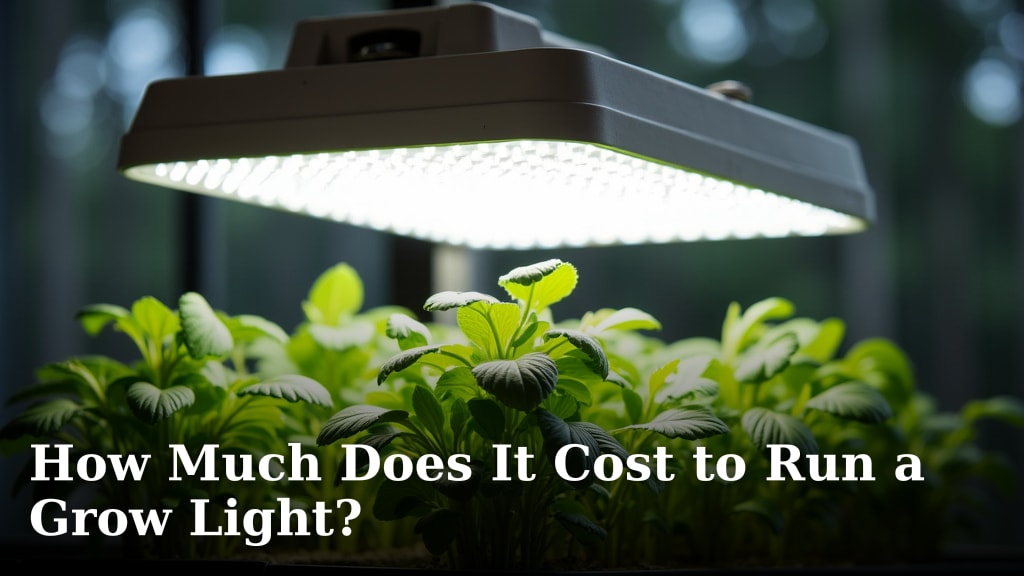
The cost to run a grow light varies significantly, but you can expect to pay anywhere from $5 to $100+ per month. This depends on your specific setup and local electricity rates. The type of grow light you choose makes a huge difference.
We found that high-intensity discharge (HID) lights are often the most expensive to operate. LED grow lights, while a bigger upfront investment, typically offer lower running costs over time. Understanding your kilowatt-hour (kWh) rate is key to figuring out your exact bill.
- Grow light costs range from $5 to $100+ monthly.
- HID lights generally cost more to run than LEDs.
- LEDs save money on electricity over time.
- Your local electricity rate is a major factor.
Ready to break down the numbers for your specific grow light setup? Let’s figure out exactly how much your green passion will cost you each month.
Estimating the Operating Cost of Your Grow Lights
Understanding how much your grow light system costs to run each month is simpler than you might think. It all boils down to a few key factors that you can easily calculate.
Your local electricity rate, the wattage of your light, and how many hours it runs all play a role. We’ll walk you through figuring out your exact monthly cost.
Understanding Your Electricity Rate
The first step is knowing your kilowatt-hour (kWh) rate. This is the price your electric company charges for each unit of electricity you use.
Think of it like buying gasoline for your car. The price per gallon is your kWh rate. This rate varies widely by location, even within the same state.
Finding Your kWh Rate
You can usually find your kWh rate directly on your electricity bill. Look for a section detailing your usage and charges. It might be listed as “Energy Charge” or “Delivery Charge.”
Sometimes, the rate changes throughout the day, especially if you have a time-of-use plan. For a simple estimate, use your average rate.
If you can’t find it on your bill, a quick call to your electricity provider will get you the answer. They’re usually happy to help you understand your bill.
The Grow Light Power Equation: Watts to kWh
Grow lights consume electricity, measured in watts. To calculate your running cost, you need to convert watts into kilowatt-hours.
One kilowatt is 1,000 watts. So, a 100-watt bulb uses 0.1 kilowatts per hour. This conversion is crucial for accurate cost estimation.
Calculating Daily kWh Usage
First, find the wattage of your grow light. This information is usually printed on the light fixture itself or in its product specifications.
Let’s say you have a 300-watt LED light. You multiply the wattage by the number of hours you run it per day. If you run it for 12 hours:
- 300 watts * 12 hours = 3,600 watt-hours per day
- To convert to kWh: 3,600 watt-hours / 1,000 = 3.6 kWh per day
This daily kWh number gives you a clear picture of its energy consumption.
Calculating Monthly Running Costs
Once you have your daily kWh usage, calculating the monthly cost is easy. Just multiply the daily kWh by the number of days in the month (usually 30 or 31).
Using our example of 3.6 kWh per day:
- 3.6 kWh/day * 30 days = 108 kWh per month
- Then, multiply by your kWh rate. If your rate is $0.15 per kWh:
- 108 kWh * $0.15/kWh = $16.20 per month
This simple formula helps you quickly estimate the impact on your budget.
Grow Light Types and Their Running Costs
Not all grow lights are created equal when it comes to electricity usage. The type of light you choose significantly impacts your monthly bill.
We found that different technologies have varying levels of efficiency. Let’s compare the most common types.
LED Grow Lights
LEDs (Light Emitting Diodes) are known for their energy efficiency. They convert more electricity into usable light and less into wasted heat.
While often more expensive upfront, their lower operating costs can save you a lot in the long run. Many growers choose them for this reason.
For example, a 300W LED might replace a much higher wattage HID light, drastically cutting electricity use.
High-Intensity Discharge (HID) Lights
HID lights include Metal Halide (MH) and High-Pressure Sodium (HPS) lamps. They are powerful but also consume more electricity.
These lights also produce a lot of heat, which can mean higher cooling costs for your grow space. We found that HID lights often have the highest running expenses.
A 600W HPS light, running 12 hours a day, would use twice the electricity of a 300W LED, leading to a much higher bill.
Fluorescent Grow Lights (T5, CFL)
Fluorescent lights like T5s or CFLs are generally less powerful and use less electricity than HIDs. They’re often used for starting seedlings or for smaller plants.
Their lower wattage means a lower cost per fixture. However, you might need many fluorescent tubes to achieve the same light intensity as a single LED or HID.
This can sometimes negate some of the individual fixture’s efficiency. They are a good choice for specific stages of plant growth.
Factors Influencing Your Total Cost Beyond the Bulb
The grow light itself is a big part of the equation, but it’s not the only factor. Other equipment in your grow space also draws power.
These additional components can subtly increase your overall electricity consumption. It’s important to consider them for a complete picture.
Ventilation and Fans
Grow lights generate heat, especially HID lights. This heat needs to be managed to maintain optimal temperatures for your plants.
Exhaust fans, oscillating fans, and sometimes even air conditioning units are necessary. These appliances all use electricity and will add to your bill.
Keeping your grow space cool and circulating air is essential for plant health, so these are often unavoidable costs.
Pumps and Other Equipment
If you’re using a hydroponic system, you’ll have water pumps running. These use electricity to circulate nutrient solutions.
Other equipment might include air pumps for aeration, humidifiers, dehumidifiers, or even small heaters. Each piece contributes to your monthly energy usage.
While individually small, these items can add up, especially if they run continuously.
Checklist for Estimating Your Grow Light Costs
Use this quick checklist to gather the necessary information for your personal cost estimate:
- Locate your electricity bill to find your average kWh rate.
- Identify the wattage of your grow light(s).
- Determine the daily run time (hours per day) for your lights.
- List any other significant electrical equipment (fans, pumps) and their wattage and run times.
- Consider potential seasonal changes in your electricity rate or light schedule.
| Light Type | Typical Wattage (Example) | Pros (Cost-wise) | Cons (Cost-wise) |
|---|---|---|---|
| LED | 100W – 600W | Very energy efficient, lower running costs. | Higher initial purchase price. |
| HID (MH/HPS) | 250W – 1000W | Lower initial purchase price. | High running costs, significant heat output (extra cooling needed). |
| Fluorescent (T5/CFL) | 20W – 100W (per bulb) | Lowest running cost per individual fixture. | May need many fixtures for intensity, less efficient than LEDs. |
Conclusion
Calculating your grow light’s running cost isn’t just about the bulb; it’s about understanding your entire grow environment. You’ve learned how to find your kWh rate and apply it to your lights and other essential equipment. This knowledge puts you in control of your budget.
By choosing the right light type and managing your setup, you can keep those energy bills in check. Your passion for growing can thrive without costing a fortune. Now, take these simple steps to dial in your precise monthly expenses!
Frequently Asked Questions
Does running grow lights at night cost less?
This depends entirely on your electricity plan. Some utility providers offer “time-of-use” rates, where electricity is cheaper during off-peak hours, often overnight. Check your electricity bill or contact your provider to see if you have such a plan.
How much will my electricity bill increase with a 600W grow light?
A 600W light running 12 hours a day consumes about 216 kWh per month (600W * 12h * 30 days / 1000). Multiply this by your specific kWh rate (e.g., $0.15/kWh) to estimate the cost. So, 216 kWh * $0.15 = $32.40 per month, plus any associated equipment like fans.
Are grow light timers worth it for saving electricity?
Absolutely, timers are crucial for saving electricity. They ensure your lights run only for the necessary duration, preventing wasted energy. Consistent light cycles also benefit your plants’ growth and health.
Do older grow lights use more electricity than new ones?
Yes, older grow light technology, especially HIDs, can become less efficient over time, using more electricity to produce the same amount of light. Newer LEDs are designed for long-term efficiency and often maintain their performance better.
How can I reduce the cost of running my grow lights?
You can reduce costs by upgrading to energy-efficient LED lights, optimizing your light schedule, and using timers. Also, insulate your grow space to minimize cooling needs, as fans and AC units add significantly to your bill.
